
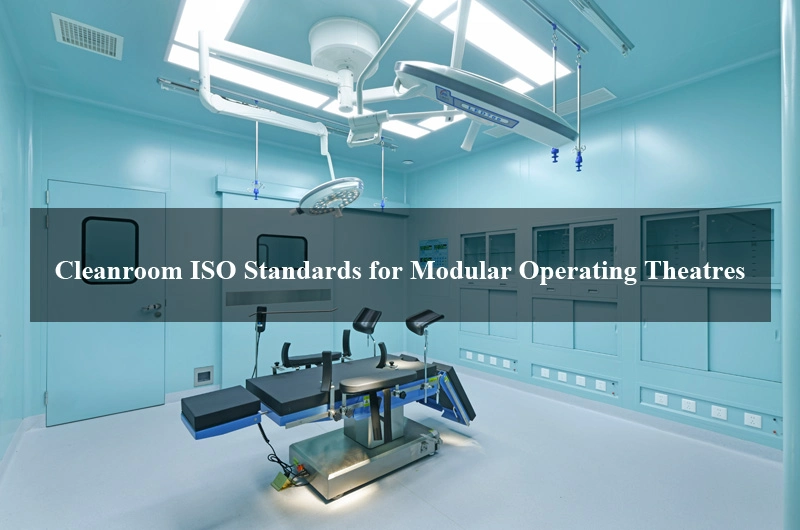
As healthcare standards continue to rise globally, modular operating theatres are increasingly designed according to international cleanroom standards to maintain sterile conditions during surgical procedures.
Among the most widely recognized standards for cleanroom classification is the ISO 14644 series, which defines air cleanliness levels and testing methods for controlled environments.
In this article, we explore the importance of ISO cleanroom standards for modular operating theatres, key classifications, airflow requirements, testing procedures, and design considerations.
What Is a Cleanroom in a Modular Operating Theatre?
A cleanroom is a tightly controlled space engineered to reduce airborne particles, microorganisms, and other contaminants.
In modular operating theatres, cleanroom systems help create sterile surgical environments by controlling:
- Airborne particle concentration
- Airflow direction
- Air pressure
- Temperature
- Humidity
- Surface contamination
The goal is to reduce the risk of surgical site infections (SSI) and maintain safe conditions during surgical procedures.
Importance of ISO Standards in Modular OT Design
ISO standards provide internationally recognized guidelines for cleanroom performance and air cleanliness classification.
For modular operating theatres, ISO compliance helps ensure:
- Consistent infection control performance
- Proper airflow management
- Reliable HVAC operation
- International healthcare quality standards
- Safer surgical environments
Many hospitals, especially international healthcare projects, require modular operating theatres to comply with ISO cleanroom classifications during design and commissioning.
Understanding ISO 14644 Cleanroom Standards
The ISO 14644 series is the global standard for cleanrooms and controlled environments.
The most important standard for modular operating theatres is:
ISO 14644-1
This standard classifies cleanrooms according to the concentration of airborne particles.
Cleanrooms are classified from:
- ISO Class 1 (extremely clean)
to - ISO Class 9 (least clean)
The lower the ISO class number, the cleaner the environment.
| ISO Class | Maximum Particles ≥0.1 µm (per m³) | ≥0.2 µm | ≥0.3 µm | ≥0.5 µm | ≥1.0 µm | ≥5.0 µm |
|---|---|---|---|---|---|---|
| ISO Class 1 | 10 | 2 | — | — | — | — |
| ISO Class 2 | 100 | 24 | 10 | 4 | — | — |
| ISO Class 3 | 1,000 | 237 | 102 | 35 | 8 | — |
| ISO Class 4 | 10,000 | 2,370 | 1,020 | 352 | 83 | — |
| ISO Class 5 | 100,000 | 23,700 | 10,200 | 3,520 | 832 | 29 |
| ISO Class 6 | 1,000,000 | 237,000 | 102,000 | 35,200 | 8,320 | 293 |
| ISO Class 7 | — | — | — | 352,000 | 83,200 | 2,930 |
| ISO Class 8 | — | — | — | 3,520,000 | 832,000 | 29,300 |
| ISO Class 9 | — | — | — | 35,200,000 | 8,320,000 | 293,000 |
Common ISO Classes Used in Modular Operating Theatres
Different hospital areas may require different cleanroom classifications depending on surgical requirements.
Typical modular OT cleanroom standards include:
| Area | Common ISO Class |
|---|---|
| Operating Theatre | ISO Class 5 to 7 |
| Laminar Airflow Zone | ISO Class 5 |
| Preparation Room | ISO Class 7 or 8 |
| Sterile Storage | ISO Class 7 or 8 |
High-risk surgeries such as orthopedic and transplant procedures may require stricter cleanroom control.
ISO Class 5 in Laminar Airflow Systems
ISO Class 5 is commonly used in the critical surgical zone directly above the operating table.
This level requires extremely low airborne particle concentration and is typically achieved through:
- Laminar airflow systems
- HEPA filtration
- Controlled air velocity
- Positive pressure ventilation
Laminar airflow creates unidirectional airflow that continuously removes airborne contaminants away from the surgical field.
This is one of the most important infection control systems in modern modular operating theatres.
HVAC Requirements for ISO Cleanroom Compliance
HVAC systems are the foundation of modular OT cleanroom performance.
To achieve ISO standards, HVAC systems must carefully control:
- Air cleanliness
- Air changes per hour (ACH)
- Temperature
- Humidity
- Pressure differentials
Typical HVAC features in modular operating theatres include:
- HEPA filters
- Laminar airflow ceilings
- Positive pressure systems
- Return air grilles
- Air balancing systems
Improper HVAC design may lead to failure in cleanroom validation and increased infection risks.
HEPA Filtration in Modular OT Cleanrooms
HEPA (High-Efficiency Particulate Air) filters are essential components in ISO-compliant operating theatres.
HEPA filters remove airborne particles and microorganisms from supplied air.
A standard HEPA filter can typically capture:
- 99.97% of particles ≥0.3 microns
Proper filter installation and maintenance are critical for maintaining cleanroom performance.
Hospitals should also conduct routine filter integrity testing to ensure system reliability.
Positive Pressure Control
Modular operating theatres are usually designed with positive air pressure relative to surrounding areas.
Positive pressure helps:
- Prevent contaminated air from entering the OT
- Maintain sterile airflow
- Reduce airborne infection risks
Pressure differentials between rooms must be carefully monitored and maintained. Poor airtightness or airflow imbalance can compromise cleanroom performance.
Cleanroom Construction Materials
ISO cleanroom standards also influence material selection in modular OT construction.
Operating theatre surfaces must be:
- Smooth
- Non-porous
- Easy to clean
- Resistant to chemicals
- Antibacterial
Common materials include:
- Stainless steel
- Powder-coated steel
- HPL wall panels
- Seamless flooring systems
Proper panel joint design is also important for minimizing particle accumulation and air leakage.
ISO Cleanroom Testing and Validation
After installation, modular operating theatres must undergo cleanroom validation testing to verify compliance with ISO standards.
Common tests include:
- Airborne particle count testing
- Airflow velocity testing
- HEPA filter integrity testing
- Room pressure testing
- Air change rate testing
- Temperature and humidity testing
These tests help confirm that the operating theatre can maintain sterile surgical conditions.
Many international projects require third-party cleanroom certification before commissioning.
Common Challenges in Achieving ISO Standards
Maintaining ISO cleanroom performance in modular operating theatres can be challenging.
Common issues include:
- Poor HVAC balancing
- Air leakage
- Improper panel sealing
- Inadequate filtration
- Incorrect airflow design
- Poor maintenance practices
Even minor installation defects can affect cleanroom classification and surgical safety.
This is why professional engineering coordination and experienced installation teams are essential.
Role of Modular Construction in ISO Compliance
Modular OT systems offer several advantages for achieving ISO cleanroom standards.
Because components are prefabricated in controlled factory environments, modular construction provides:
- Better manufacturing precision
- Improved panel alignment
- Consistent quality control
- Reduced on-site contamination
- Faster installation
These advantages help improve cleanroom performance and simplify validation procedures.