
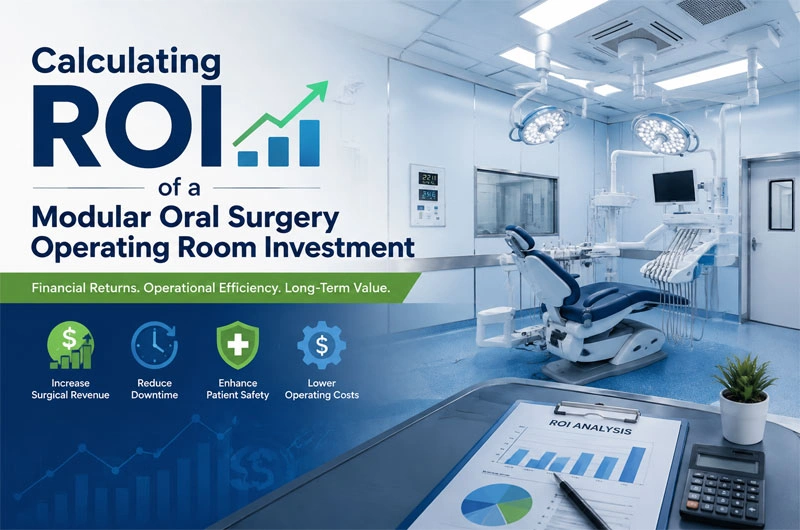
For many dental hospitals and oral surgery centers, investing in a dedicated operating room is not simply a construction decision — it is a long-term business and clinical performance decision.
Traditional evaluation methods often focus only on the initial construction cost:
- How much does the operating room cost?
- How long does installation take?
- What is the price difference compared with conventional construction?
However, this approach overlooks the real financial impact of an oral surgery operating room.
A well-designed modular oral surgery operating room can generate value through multiple channels:
- Increasing surgical capacity
- Reducing procedure downtime
- Improving infection control performance
- Supporting premium surgical services
- Lowering maintenance costs
- Allowing future expansion
Therefore, the correct ROI calculation should not only consider investment cost, but also measure how the operating room contributes to hospital revenue growth and operational efficiency.
1. Understanding the True Investment Cost of a Modular Oral Surgery Operating Room
The first mistake many healthcare investors make is comparing only the purchase price.
A modular oral surgery operating room investment includes several components:
1.1 Design and Engineering Cost
Unlike conventional rooms, modular operating rooms require specialized planning:
- Room layout design
- Airflow simulation
- Clean zone planning
- Medical gas planning
- Electrical system design
- Equipment integration
A professional design phase helps avoid costly modifications after installation.
1.2 Manufacturing Cost
A modular oral surgery operating room is manufactured in a controlled factory environment.
Typical components include:
- Antibacterial wall panels
- Ceiling systems
- Hermetic doors
- Observation windows
- HEPA filtration systems
- Lighting systems
- Medical equipment interfaces
Factory manufacturing provides:
- Higher quality consistency
- Shorter onsite construction time
- Better contamination control
1.3 Installation and Commissioning Cost
A complete solution should include:
- Transportation
- Installation
- System testing
- Air quality validation
- Final commissioning
The advantage of modular construction is that most components are prefabricated before arriving onsite, reducing unpredictable construction expenses.
2. The Revenue Impact: How a Modular OR Creates Financial Returns
The biggest difference between a normal room and a surgical-grade oral operating room is revenue-generating capability.
A dedicated oral surgery operating room allows hospitals to perform more advanced procedures, such as:
- Dental implant surgery
- Complex oral reconstruction
- Bone grafting
- Orthognathic surgery
- Maxillofacial procedures
These procedures typically have higher clinical value compared with routine dental treatments.
3. Calculating Additional Revenue from Increased Surgical Capacity
A simple ROI model can start with additional annual procedures.
Example Scenario:
A dental hospital invests in one modular oral surgery operating room.
Assumptions:
| Item | Value |
|---|---|
| Working days per year | 250 days |
| Additional surgeries per week | 10 cases |
| Average revenue per surgery | $1,000 |
| Annual additional surgeries | 500 cases |
Annual additional revenue:
500 × $1,000 = $500,000
Even before considering other benefits, increased surgical capacity can significantly shorten investment recovery time.
4. Reducing Operating Downtime: The Hidden ROI Factor
Many hospitals underestimate the financial impact of construction delays.
Traditional construction often involves:
- Multiple contractors
- Unexpected site problems
- Material delays
- Rework after inspection
For healthcare facilities, every month of delay means:
- Lost surgical revenue
- Delayed patient acquisition
- Idle medical equipment
A modular solution reduces this risk because:
- Manufacturing happens simultaneously with site preparation
- Installation is faster
- Quality control happens before delivery
Example:
Assume:
- Potential monthly surgical revenue: $80,000
- Traditional construction delay: 3 months
Lost opportunity:
$80,000 × 3 = $240,000
A faster modular installation can protect this revenue opportunity.
5. Infection Control and Cost Avoidance: The Often Ignored ROI
ROI should not only measure additional revenue.
It should also consider avoided costs.
Oral surgery has unique infection risks because procedures generate:
- Aerosols
- Blood contamination
- Biological particles
A properly designed modular operating room helps hospitals control:
- Air cleanliness
- Pressure balance
- Surface contamination
- Cleaning efficiency
Potential financial benefits include:
Lower Infection-Related Costs
Reducing postoperative complications can decrease:
- Additional treatments
- Antibiotic usage
- Patient complaints
- Reputation risks
For private hospitals, avoiding one serious infection event can represent significant financial protection.
6. Operational Efficiency: More Procedures Without Expanding the Building
Space is one of the most valuable resources in healthcare facilities.
A traditional approach often requires:
- Larger rooms
- More supporting spaces
- Longer patient movement paths
A modular oral surgery operating room can optimize:
Surgical Workflow
By integrating:
- Surgeon zone
- Assistant zone
- Instrument zone
- Equipment zone
- Patient transfer area
Better workflow can reduce:
- Preparation time
- Cleaning turnaround time
- Staff movement
Even saving 20–30 minutes per procedure can create additional surgical capacity.
7. Maintenance Cost and Lifecycle ROI
A common mistake is evaluating only the first-year investment.
Healthcare infrastructure should be evaluated over 10–20 years.
A modular operating room offers lifecycle advantages:
Easier Maintenance
Modular components allow:
- Faster replacement
- Easier upgrades
- Less disruption
Future Expansion
Hospitals can:
- Add additional rooms
- Modify layouts
- Upgrade systems
This flexibility reduces future renovation costs.
8. A Practical ROI Calculation Model
A comprehensive ROI calculation should include:
Annual Financial Benefit
=
Additional surgical revenue
Operational efficiency savings
Reduced infection-related costs
Maintenance savings
Then:
ROI Formula:
ROI (%) = (Annual Financial Benefit – Annual Operating Cost) ÷ Initial Investment × 100
9. Example Five-Year ROI Analysis
Assume:
Initial Investment
Modular oral surgery operating room:
$500,000
Annual Benefits:
| Source | Annual Value |
|---|---|
| Additional surgery revenue | $400,000 |
| Efficiency improvement | $50,000 |
| Infection risk reduction | $30,000 |
| Maintenance savings | $20,000 |
| Total Annual Benefit | $500,000 |
Five-year benefit:
$500,000 × 5 = $2,500,000
Estimated ROI:
($2,500,000 – $500,000) ÷ $500,000
= 400%
10. Why Modular OR ROI Is Different from Traditional Construction ROI
Traditional construction creates a physical space.
A modular oral surgery operating room creates a clinical productivity platform.
The investment value comes from:
| Traditional View | Better ROI View |
|---|---|
| Room cost | Surgical capacity |
| Construction speed | Earlier revenue generation |
| Building materials | Infection control performance |
| Floor area | Procedure efficiency |
| Initial investment | Lifetime value |
11. Key Factors That Determine ROI Success
Not every modular operating room automatically delivers high returns.
The following factors are critical:
1. Professional Layout Design
Poor workflow design limits productivity.
2. Correct Cleanroom Configuration
Airflow and contamination control directly influence performance.
3. Integration with Surgical Equipment
The room must support:
- Dental chairs
- Imaging systems
- Medical gases
- Surgical instruments
4. Reliable Manufacturer Capability
A successful project requires:
- Engineering expertise
- Factory production capability
- Installation experience
- After-sales support
Conclusion
For modern dental hospitals, the question should not be:
“How much does a modular oral surgery operating room cost?”
The more important question is:
“How much value can this operating room generate throughout its lifecycle?”
A well-designed modular oral surgery operating room can help healthcare providers:
- Increase surgical revenue
- Improve patient safety
- Optimize workflow
- Reduce operational risks
- Prepare for future expansion
When evaluated through a complete ROI framework, modular oral surgery operating rooms are not simply infrastructure investments — they are strategic assets that support long-term healthcare growth.