
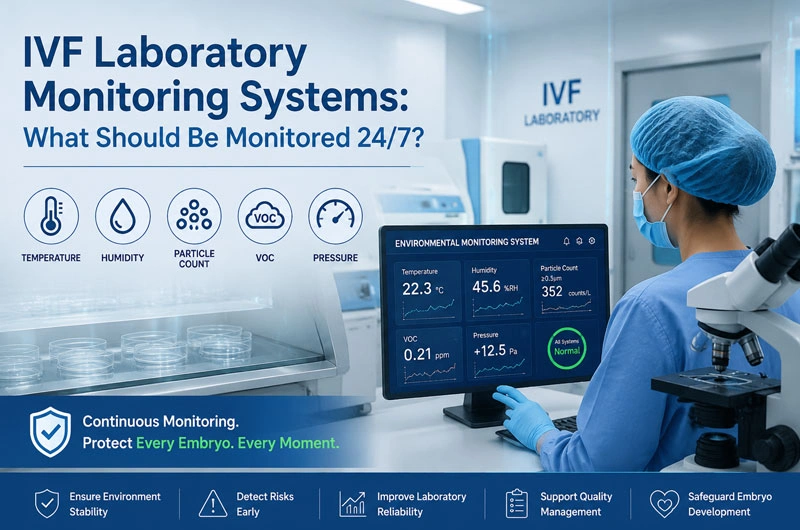
In an IVF laboratory, embryos are exposed to a highly controlled artificial environment during one of the most sensitive stages of human development. Unlike many medical environments where short-term environmental fluctuations may have limited impact, IVF laboratories operate within a narrow tolerance window.
A temperature change of only a few degrees, a sudden increase in airborne particles, or an unnoticed pressure imbalance may not immediately appear as a visible failure — but can gradually affect embryo culture stability, laboratory cleanliness, and ultimately clinical outcomes.
Traditional IVF laboratory management often relies on periodic manual inspections. However, modern fertility centers are increasingly adopting continuous environmental monitoring systems that collect real-time data, generate alerts, and provide historical records for quality control.
A professional IVF laboratory monitoring system should not only answer:
“Is the environment acceptable right now?”
It should also answer:
“Was the environment stable throughout the entire embryo development process?”
The following five parameters are critical for 24/7 monitoring.
1. Temperature Monitoring
Temperature is one of the most important environmental factors in IVF laboratories because embryos are extremely sensitive to thermal stress.
During embryo culture, gametes and embryos are maintained under conditions designed to mimic the human reproductive environment. Even small temperature deviations during:
- Handling procedures
- Microscope observation
- Culture periods
- Media preparation
- Storage processes
may influence embryo metabolism and development.
What Should Be Monitored?
A comprehensive IVF temperature monitoring system should track:
Laboratory Air Temperature
The overall laboratory temperature affects:
- Operator comfort
- Equipment stability
- Incubator performance
- Heat exchange conditions
Typical IVF laboratories maintain temperatures around 20–24°C, depending on laboratory design standards and equipment requirements.
Incubator Temperature
Incubators are the most critical temperature-controlled devices.
Monitoring should include:
- Internal incubator temperature
- Temperature recovery time after door opening
- Temperature fluctuations over time
- Alarm history
A common mistake is monitoring only the incubator display.
Why?
Because a display shows the current condition, but not whether there were unnoticed fluctuations overnight or during weekends.
Expert Insight:
The value of temperature monitoring is not the number itself — it is the stability curve.
An incubator that stays at 37°C with frequent fluctuations may create more risk than an incubator maintaining a slightly different but extremely stable environment.
Therefore, IVF monitoring systems should focus on:
Temperature stability + recovery speed + historical trends
rather than simple pass/fail measurement.
2. Humidity Monitoring
Humidity is often overlooked in IVF laboratory design, but it plays an important role in maintaining a stable laboratory environment.
Incorrect humidity levels can influence:
- Culture media evaporation
- Osmolality changes
- Static electricity generation
- Equipment performance
- Operator comfort
Why Does Humidity Matter in IVF?
Culture media contains precisely balanced components, including:
- Salts
- Proteins
- Nutrients
- Buffers
Excessive evaporation can gradually change media concentration, affecting embryo culture conditions.
For example:
A culture dish exposed to an unstable environment may experience increased evaporation during handling, changing the chemical balance of the medium.
What Should Be Monitored?
A 24/7 humidity monitoring system should record:
- Relative humidity percentage
- Sudden humidity changes
- Long-term humidity trends
- Relationship between humidity and HVAC operation
Many IVF laboratories maintain relative humidity around 40–60%, depending on local climate and HVAC design.
Expert Insight:
Humidity should not be considered an independent parameter.
It is closely connected with:
- Temperature control
- HVAC performance
- Air exchange rate
A sudden humidity increase may indicate:
- HVAC malfunction
- Door leakage
- Excessive outside air infiltration
Therefore, humidity data can become an early warning signal for larger system problems.
3. Particle Count Monitoring
Clean air is one of the foundations of IVF laboratory safety.
Although microorganisms are invisible, airborne particles often act as carriers for:
- Bacteria
- Dust
- Chemical contaminants
- Human-derived particles
A particle monitoring system provides measurable evidence of laboratory cleanliness.
What Should Be Monitored?
Typical monitoring includes:
- ≥0.5 μm particles
- ≥5 μm particles
Continuous monitoring helps identify:
- HVAC filtration problems
- HEPA filter degradation
- Excessive personnel activity
- Door opening problems
- Cleaning procedure issues
Why Continuous Monitoring Matters
A laboratory may pass a particle test during annual certification but experience contamination events during daily operation.
For example:
A sudden increase in particle levels may occur because of:
- Increased staff movement
- Construction activities nearby
- Air balancing problems
- Filter replacement issues
Without continuous monitoring, these events may remain unnoticed.
Expert Insight:
Particle monitoring should be used as a behavior and system performance indicator.
A rising particle trend may reveal not only air quality problems but also:
- Poor workflow design
- Excessive movement inside the laboratory
- Inefficient zoning
This means environmental monitoring can provide insights into laboratory operation efficiency.
4. VOC Monitoring
Volatile Organic Compounds (VOC) are increasingly recognized as a critical factor in IVF laboratory environmental control.
VOC sources may include:
- Cleaning agents
- Adhesives
- Furniture materials
- Building materials
- Laboratory consumables
- Plastic products
Some VOCs may affect embryo development even at very low concentrations.
What Should Be Monitored?
A VOC monitoring system should detect:
- Total VOC concentration (TVOC)
- Long-term VOC trends
- Sudden contamination events
Why VOC Monitoring Is Different From Particle Monitoring
Particle monitoring detects physical contamination.
VOC monitoring detects chemical contamination.
A laboratory can have:
- Excellent particle control
- Good air pressure
- Clean surfaces
but still experience chemical contamination.
Expert Insight:
VOC monitoring is especially important for:
- New IVF laboratory construction
- Modular IVF laboratories
- Recently renovated fertility centers
New materials may release chemicals through:
- Paints
- Sealants
- Flooring
- Wall panels
Therefore, VOC monitoring should begin before clinical operation and continue after commissioning.
5. Pressure Monitoring
Pressure control is the foundation of cleanroom airflow management.
IVF laboratories typically use positive pressure systems to prevent contaminated air from entering controlled areas.
What Should Be Monitored?
Pressure monitoring should include:
- Room-to-room pressure differential
- Airflow direction
- Pressure alarm status
Critical areas may include:
- Embryology laboratory
- Andrology laboratory
- Operating rooms
- Preparation rooms
- Storage areas
Why Pressure Stability Matters
A positive pressure environment creates an invisible protective barrier.
When doors open:
Clean filtered air should flow outward rather than allowing contaminated air to enter.
However, pressure imbalance may occur due to:
- HVAC failure
- Blocked filters
- Incorrect air balancing
- Excessive door opening
Expert Insight:
Pressure monitoring is not only about maintaining numbers.
It verifies whether the laboratory zoning strategy is working.
A well-designed IVF laboratory should create a controlled contamination pathway:
Less clean area → More clean area
not the opposite.
Conclusion
A successful IVF laboratory depends on more than advanced incubators and skilled embryologists.
It requires a stable, predictable, and measurable environment.
24/7 monitoring of:
- Temperature
- Humidity
- Particle count
- VOC
- Pressure
allows fertility centers to identify risks before they become failures.