
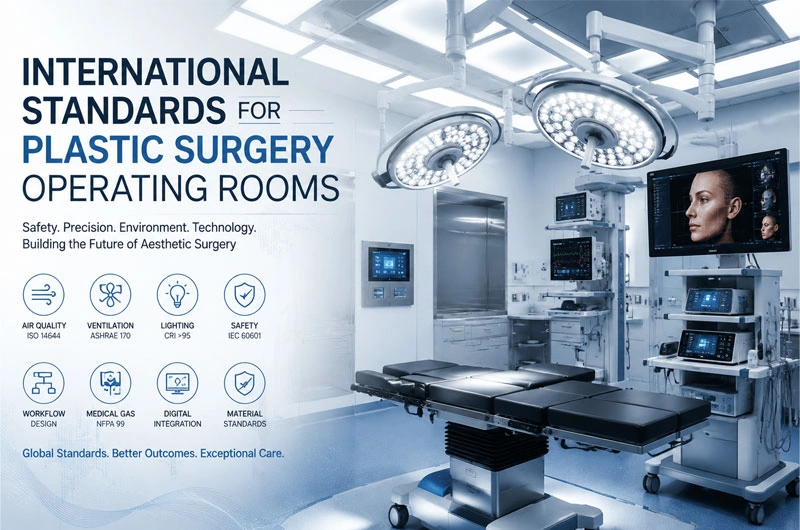
Plastic surgery is unique among surgical specialties. While it requires the same infection prevention standards as general surgery, it also demands superior lighting, meticulous environmental control, advanced imaging integration, and an operating environment that directly influences aesthetic outcomes.
Many hospitals focus solely on meeting minimum operating room regulations. However, leading plastic surgery centers are increasingly designing operating rooms that exceed international standards to improve surgical precision, reduce revision rates, enhance patient comfort, and strengthen their global reputation.
This article explores the international standards that define modern plastic surgery operating rooms—and explains why future-ready facilities require much more than clean air.
Why Plastic Surgery Operating Rooms Require Higher Standards
Unlike emergency surgery, plastic surgery is highly detail-oriented.
Examples include:
- Facial reconstruction
- Rhinoplasty
- Breast augmentation
- Liposuction
- Body contouring
- Microsurgical flap reconstruction
Procedures often last several hours while requiring millimeter-level precision.
A small environmental disturbance—poor lighting, unstable temperature, excessive equipment movement, or inconsistent airflow—can negatively affect outcomes.
Therefore, international standards focus on creating an operating environment that supports both clinical safety and surgical precision.
Major International Standards
| Standard | Organization | Primary Focus |
|---|---|---|
| ISO 14644 | International Organization for Standardization | Cleanroom air cleanliness |
| HTM 03-01 | NHS (UK) | Ventilation for healthcare facilities |
| ASHRAE 170 | American Society of Heating, Refrigerating and Air-Conditioning Engineers | Hospital ventilation |
| FGI Guidelines | United States | Healthcare facility planning |
| WHO Safe Surgery | World Health Organization | Surgical safety |
| NFPA 99 | National Fire Protection Association | Medical gas systems |
| IEC 60601 | International Electrotechnical Commission | Medical electrical equipment |
| EN 13795 | European Standard | Surgical drapes and gowns |
Rather than relying on one regulation, high-end plastic surgery hospitals often combine multiple international standards.
1. Air Cleanliness (ISO 14644)
Airborne contamination remains one of the leading causes of surgical site infections.
Plastic surgery procedures involving implants (such as breast augmentation or facial implants) require especially clean environments.
Typical recommendations include:
| Area | Typical ISO Class |
|---|---|
| Operating zone | ISO Class 5–7 |
| Peripheral area | ISO Class 7–8 |
| Preparation room | ISO Class 8 |
Although cosmetic surgery has relatively low infection rates, implant-related procedures have much stricter contamination requirements.
The operating table should remain inside the laminar airflow protection zone throughout surgery.
2. Positive Pressure Ventilation
International healthcare ventilation standards consistently recommend positive pressure operating rooms.
Benefits include:
- Prevents contaminated corridor air entering the OR
- Maintains sterile airflow
- Protects implant procedures
- Reduces airborne bacteria
Typical pressure differential:
+5 to +15 Pa
between operating room and adjacent spaces.
3. Laminar Airflow Is Becoming the New Standard
Older operating rooms often relied on mixed ventilation.
Modern plastic surgery centers increasingly install vertical laminar airflow systems.
Advantages include:
- Uniform particle removal
- Cleaner surgical field
- Reduced turbulence
- Better protection during long procedures
For aesthetic procedures lasting 4–8 hours, airflow stability becomes increasingly important.
4. Temperature and Humidity Control
Plastic surgery surgeons frequently request cooler operating environments than other specialties.
Recommended environmental parameters:
| Parameter | Typical Range |
|---|---|
| Temperature | 20–24°C |
| Relative humidity | 40–60% |
| Air changes per hour | ≥20 ACH |
Stable humidity also reduces electrostatic discharge that may affect sensitive medical equipment.
5. Surgical Lighting Standards
Unlike orthopedic surgery, plastic surgery requires exceptional color rendering.
High-quality LED surgical lights should provide:
- Illuminance up to 160,000 lux
- Adjustable color temperature
- CRI >95
- Minimal shadow formation
- Low heat emission
Accurate tissue color visualization is essential for:
- Skin flap viability
- Fat graft evaluation
- Facial symmetry
- Vascular assessment
Lighting quality directly influences aesthetic judgment.
6. Medical Gas System Standards
International operating room standards require centralized medical gas systems.
Typical outlets include:
- Oxygen
- Medical air
- Vacuum
- Nitrous oxide (where applicable)
Each outlet should comply with national connector standards to prevent cross-connections.
Emergency shutoff valves should remain immediately accessible.
7. Electrical Safety and Equipment Integration
Plastic surgery operating rooms contain increasing numbers of electronic devices:
- Electrosurgical units
- Surgical microscopes
- Endoscopic systems
- Anesthesia machines
- HD cameras
- Patient warming devices
International standards recommend:
- Isolated power systems
- Equipotential grounding
- Sufficient ceiling-mounted power outlets
- UPS backup
- Surge protection
Equipment integration minimizes cable clutter and improves workflow.
8. Surface Materials Must Support Infection Control
Wall and ceiling systems should be:
- Seamless
- Non-porous
- Chemical resistant
- Scratch resistant
- Easy to disinfect
- Antibacterial
Modern modular operating rooms commonly use:
- Antibacterial HPL panels
- Electro-galvanized steel panels
- Stainless steel accessories
Smooth surfaces reduce microbial accumulation and simplify cleaning.
9. Workflow Design Is an International Quality Indicator
International healthcare guidelines increasingly emphasize workflow rather than equipment alone.
An optimized plastic surgery suite typically separates:
| Functional Zone | Purpose |
|---|---|
| Patient preparation | Pre-operative preparation |
| Scrub area | Surgical hand preparation |
| Operating room | Sterile procedure |
| Sterile storage | Instrument management |
| Dirty utility | Waste collection |
| Recovery room | Immediate post-operative care |
This separation minimizes cross-contamination and improves staff efficiency.
10. Digital Integration Is Becoming a Global Benchmark
Modern plastic surgery operating rooms increasingly integrate digital technologies into daily workflows.
Common features include:
- HD surgical video recording
- Ceiling-mounted 4K displays
- PACS image access
- Digital operating room control panels
- Voice-controlled systems
- Surgical documentation integration
- AI-assisted image comparison (where permitted)
These technologies enhance documentation, education, and multidisciplinary collaboration while supporting consistent surgical quality.
Plastic Surgery Has Unique Design Requirements
Compared with general operating rooms, plastic surgery facilities often require additional design considerations.
| Design Factor | General OR | Plastic Surgery OR |
|---|---|---|
| Lighting accuracy | High | Very High |
| Color rendering | Standard | Critical |
| Photography support | Rare | Essential |
| Implant surgery | Moderate | Frequent |
| Microsurgery compatibility | Sometimes | Often |
| Patient comfort | Standard | High |
| Aesthetic workflow | Limited | Critical |
These factors make plastic surgery operating rooms some of the most technically demanding environments in modern healthcare.
Future Trends in International Plastic Surgery Operating Rooms
The next generation of operating rooms is evolving beyond compliance toward intelligent, patient-centered design.
Key trends include:
- Modular operating room construction for faster installation and easier future upgrades.
- AI-assisted environmental monitoring with real-time tracking of particles, pressure, temperature, and humidity.
- Touchless control systems to reduce contact points and support aseptic practice.
- Energy-efficient ventilation using demand-controlled airflow to lower operating costs while maintaining air quality.
- Integrated digital ecosystems that connect imaging, documentation, anesthesia, and equipment management.
- Human-centered design featuring quieter HVAC systems, circadian-adjustable lighting, and improved ergonomics for surgical teams.
These innovations reflect a shift from simply meeting regulatory requirements to creating operating environments that improve outcomes, enhance efficiency, and support long-term sustainability.