
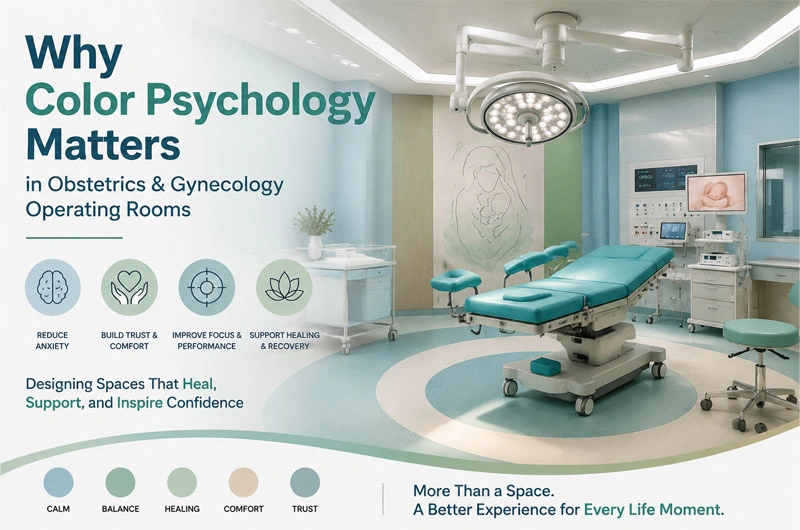
When designing an Obstetrics & Gynecology (OB/GYN) operating room, most hospitals focus on infection control, airflow management, lighting levels, medical equipment placement, and workflow efficiency.
However, one critical factor is often overlooked: the psychological impact of the environment itself.
An operating room is not only a technical space—it is also a place where patients experience some of the most emotionally significant moments of their lives:
- A mother preparing for a cesarean section
- A woman undergoing gynecological surgery
- A family waiting for the arrival of a newborn
- Medical teams performing high-pressure procedures
Unlike many other surgical environments, OB/GYN operating rooms combine clinical precision with emotional sensitivity. Therefore, color selection is not simply an aesthetic decision; it is a design strategy that can influence anxiety levels, staff concentration, patient comfort, and the overall perception of care quality.
Modern modular OB/GYN operating rooms are moving from purely functional spaces toward human-centered surgical environments, where color psychology becomes an essential design element.
The Unique Psychological Needs of OB/GYN Operating Rooms
Traditional operating room design usually prioritizes:
- White walls
- Stainless steel surfaces
- Neutral lighting
- Minimal decoration
This approach supports cleanliness and professionalism, but excessive use of cold colors can unintentionally create an environment that feels:
- Impersonal
- Stressful
- Institutional
- Emotionally distant
For general surgery, this may be acceptable. But OB/GYN surgery has a different emotional context.
A patient entering an OB/GYN operating room may already experience:
- Fear of surgery
- Anxiety about anesthesia
- Concern about personal health
- Emotional anticipation related to childbirth
Therefore, the environment should help achieve three psychological goals:
1. Reduce anxiety before surgery
Colors can influence the autonomic nervous system. Softer tones and balanced color schemes can help create a calmer perception of the surgical environment.
2. Build trust and emotional comfort
A carefully designed operating room communicates:
“This hospital cares not only about the procedure but also about the patient’s experience.”
3. Support medical staff performance
Surgeons and nurses work in these spaces for many hours. Color environments can affect visual fatigue, alertness, and concentration.
How Different Colors Influence OB/GYN Operating Room Design
Blue
Blue is one of the most common colors used in healthcare environments.
Psychological effects:
- Creates a sense of calm
- Reduces perceived stress
- Represents cleanliness and reliability
- Helps maintain professional atmosphere
In OB/GYN operating rooms, blue is particularly suitable for:
- Wall panels
- Surgical doors
- Ceiling elements
- Observation windows
However, excessive dark blue should be avoided because it may create a cold atmosphere.
Design recommendation:
Use soft blue-gray tones rather than hospital-style deep blue.
Example:
| Area | Recommended Blue Application |
|---|---|
| Operating room walls | Light blue-gray panels |
| Control panels | Medium blue accents |
| Storage cabinets | Soft blue details |
Green
Green has historically been associated with operating rooms because surgeons often use green or blue surgical gowns.
The reason is not only tradition.
Green provides:
Visual balance
During surgery, medical professionals frequently observe red tissues and blood. Looking at green surfaces helps reduce visual fatigue because green is opposite red on the color spectrum.
Emotional stability
Green represents:
- Recovery
- Nature
- Balance
- Renewal
These meanings are especially relevant in maternity-related spaces.
For OB/GYN operating rooms, green can be integrated into:
- Wall decoration
- Modular panel colors
- Nurse workstation areas
- Recovery room transitions
A modern approach is using:
- Sage green
- Soft mint
- Medical green-gray
rather than traditional operating-room green.
Warm Colors
Warm colors such as beige, cream, and light wood tones are increasingly used in modern healthcare design.
Why?
Because patients often associate traditional hospitals with:
- White walls
- Metal surfaces
- Cold lighting
Warm colors introduce a more welcoming feeling.
Suitable applications:
Patient preparation areas
Before entering surgery, patients spend time preparing mentally.
Warm neutral colors can reduce the feeling of entering a high-risk environment.
Recovery rooms
After surgery, patients need comfort and reassurance.
Soft beige or natural tones can create a more relaxing atmosphere.
Why Pure White Operating Rooms Are No Longer Enough
White has always represented:
- Cleanliness
- Sterility
- Professionalism
However, completely white environments have limitations.
Problem 1: Visual fatigue
Large white surfaces reflect strong light, which may increase eye strain for medical staff during long procedures.
Problem 2: Emotional distance
Patients may perceive completely white environments as:
- Cold
- Unfriendly
- Highly clinical
Problem 3: Lack of spatial identity
Modern hospitals increasingly focus on patient experience and brand perception.
A well-designed OB/GYN operating room should feel:
Sterile + Safe + Human
not only:
Sterile + Functional
Color Zoning
Instead of applying one color throughout the entire surgical area, advanced operating room design uses functional color zoning.
Different zones can communicate different psychological messages.
Example:
| Area | Recommended Colors | Design Purpose |
|---|---|---|
| Patient preparation room | Warm beige, soft green | Reduce anxiety |
| Operating room | Blue-gray, green accents | Precision and focus |
| Recovery room | Warm neutral colors | Comfort and relaxation |
| Sterilization area | White, light gray | Cleanliness and efficiency |
| Storage area | Neutral colors with identification accents | Organization |
This approach creates a psychological journey:
Anxiety → Confidence → Treatment → Recovery
Color Selection Must Consider Lighting and Materials
One common mistake in hospital design is choosing colors independently from lighting systems.
In operating rooms, colors are affected by:
- LED color temperature
- Surgical lights
- Wall panel materials
- Surface reflection
- Cleanability requirements
For example:
A light green wall under a cold 6500K LED light may appear blue-gray.
A beige panel under warm lighting may appear yellow.
Therefore, color decisions should be evaluated together with:
- Lighting simulation
- Material samples
- Mock-up rooms
before final installation.
Modular Operating Rooms Provide More Opportunities for Color Psychology
Compared with traditional construction, modular OB/GYN operating rooms offer greater flexibility.
Manufacturers can customize:
- Antibacterial wall panels
- Ceiling systems
- Doors
- Cabinets
- Control panels
- Medical furniture
This allows hospitals to create a consistent visual identity while maintaining strict hygiene standards.
For example:
A maternity hospital may choose:
- Soft blue for trust
- Sage green for healing
- Warm wood patterns for emotional comfort
while still meeting:
- Cleanroom requirements
- Infection control standards
- Easy-clean surface requirements
Final Words
In OB/GYN operating room design, color should not be treated as a decorative choice.
It is a functional design tool that can influence:
- Patient anxiety
- Emotional comfort
- Staff concentration
- Perceived quality of care
- Hospital brand identity
The best operating rooms combine:
Advanced infection control + ergonomic workflow + human-centered color design