
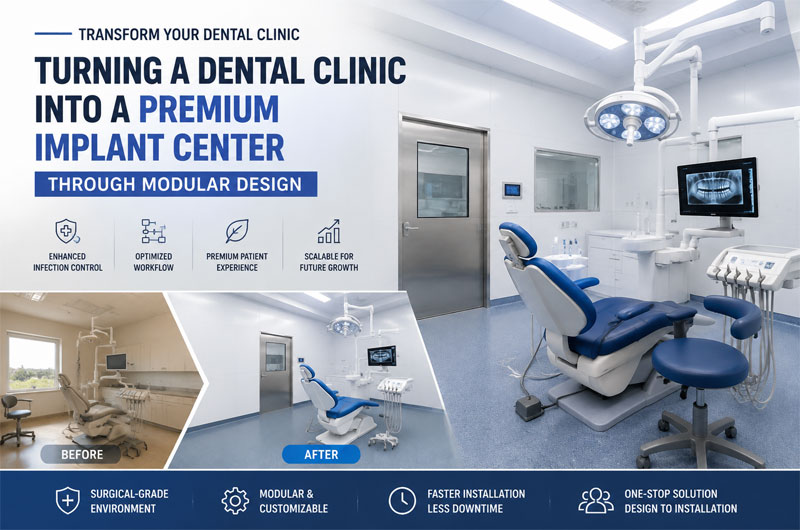
The dental industry is undergoing a significant transformation. As implant dentistry becomes more advanced, patients are no longer choosing clinics only based on the reputation of dentists or the availability of implant systems. They are increasingly evaluating the entire treatment experience — from the first consultation to the surgical environment.
A modern implant center must deliver three things simultaneously:
- Clinical excellence
- High-level infection control
- A premium patient experience
However, many existing dental clinics were originally designed for general dentistry rather than complex surgical procedures. Limited space, insufficient infection control measures, inefficient workflows, and outdated infrastructure often prevent them from operating like true implant centers.
This is where modular oral surgery OR design provides a new approach.
Instead of rebuilding a dental facility through traditional construction, modular technology allows clinics to transform existing spaces into professional implant surgery environments with controlled air quality, optimized workflows, and future expansion capabilities.
1. The Challenge: A Dental Clinic Is Not Automatically an Implant Center
Many dental clinics believe that adding implant equipment is enough to become an implant center.
In reality, implant surgery requires a completely different operational environment.
A typical dental treatment room may focus on:
- Patient comfort
- Routine procedures
- Equipment accessibility
But implant surgery requires:
- Strict contamination control
- Sterile instrument management
- Surgical workflow planning
- Controlled airflow
- Dedicated preparation areas
- Better environmental stability
The difference is similar to upgrading from a general office to a professional laboratory.
The equipment may be important, but the environment determines performance consistency.
2. Modular Design Changes the Way Implant Centers Are Built
Traditional renovation usually follows this process:
- Remove existing structures
- Modify walls and ceilings
- Install electrical and medical systems
- Build ventilation systems
- Conduct testing
- Adjust problems on site
This approach often creates challenges:
- Long construction periods
- Multiple contractors
- Unclear responsibility
- Unexpected costs
- Limited future flexibility
Modular design takes a different approach.
The implant center is treated as a complete medical environment manufactured and prepared before installation.
The process includes:
- Customized layout design
- Factory production of wall and ceiling systems
- Integration of medical utilities
- Controlled installation
- Final testing and validation
This allows dental clinics to upgrade their surgical capabilities with less disruption to daily operations.
3. Creating a Surgical Environment Instead of Just a Beautiful Clinic
Premium implant centers are not defined only by expensive decoration.
A truly advanced implant facility combines:
Environmental Control
The surgical environment must maintain stable conditions:
- Clean air circulation
- HEPA filtration
- Positive pressure control
- Reduced airborne contamination
Workflow Optimization
The layout should minimize unnecessary movement.
A well-designed implant center considers:
- Where instruments are prepared
- How staff enter the surgical area
- How materials move
- Where sterilization connects with surgery
Every additional step creates potential inefficiency.
Good modular design turns the room layout into a workflow advantage.
4. Infection Control Becomes a Competitive Advantage
Dental implant procedures involve surgical exposure of bone and tissue.
Even minor contamination risks may influence:
- Healing outcomes
- Patient confidence
- Clinical reputation
Traditional dental rooms often struggle with:
- Aerosol generation
- Frequent door opening
- Shared circulation systems
- Difficult-to-clean surfaces
A modular oral surgery operating room addresses these challenges through:
Seamless Interior Surfaces
Medical-grade wall panels reduce:
- Dust accumulation
- Bacteria attachment points
- Cleaning difficulty
Controlled Air Movement
Airflow design helps:
- Remove airborne particles
- Maintain cleaner surgical zones
- Reduce contamination risks
Dedicated Surgical Zones
Separating surgical activities from routine dental treatments improves overall infection control.
5. Premium Patient Experience Starts Before Surgery
Patients undergoing implant treatment often experience anxiety.
The environment influences their perception of professionalism.
A premium implant center communicates trust through:
- Clean and organized spaces
- Advanced medical appearance
- Comfortable preparation areas
- Efficient staff workflow
Modular design allows clinics to create a consistent experience:
From:
“small dental clinic offering implants”
to:
“specialized implant surgery center”
This difference matters when patients compare treatment providers.
6. Modular Design Helps Dental Clinics Scale Their Business
One overlooked advantage of modular design is future expansion.
Dental businesses rarely remain unchanged.
Successful implant centers may later need:
- Additional operating rooms
- Recovery spaces
- Sterilization areas
- Consultation rooms
- Training facilities
Traditional construction makes expansion complicated.
Modular systems provide flexibility because components can be:
- Modified
- Expanded
- Reconfigured
The facility can grow together with the business.
7. Turning Existing Space Into High-Value Surgical Capacity
Many dental investors face a common problem:
They already have a clinic location, but the space cannot support premium implant procedures.
Building a new facility may require:
- Large capital investment
- Long approval periods
- Business interruption
Modular transformation provides another option:
Upgrade existing space into a surgical-grade implant center.
For example:
Existing clinic:
- 5 dental chairs
- General treatment rooms
- Basic ventilation
After modular upgrade:
- Dedicated implant operating room
- Controlled surgical environment
- Improved infection prevention
- Premium patient positioning
The value is not simply adding a room.
It is increasing the clinical capability of the entire facility.
8. Why Modular Design Is Especially Valuable for International Implant Centers
In many emerging markets, dental implant demand is growing rapidly.
However, healthcare infrastructure development faces challenges:
- Lack of experienced medical contractors
- Limited cleanroom construction expertise
- Difficulty controlling project quality
A modular solution reduces these risks by providing:
- Factory-Controlled Quality: Components are manufactured under controlled conditions.
- One Responsible Partner: Design, manufacturing, and installation are coordinated by one supplier.
- Faster Project Completion: Compared with traditional construction, modular installation can significantly shorten project timelines.
Conclusion
Turning a dental clinic into a premium implant center is not simply about adding implant machines or renovating interiors.
It requires a fundamental upgrade in:
- Clinical environment
- Infection control capability
- Operational efficiency
- Patient perception
- Long-term scalability
A modular oral surgery operating room allows dental clinics to make this transition faster and more strategically.
For dental investors and healthcare operators, modular design is not just a construction method — it is a pathway to building the next generation of premium implant centers.