
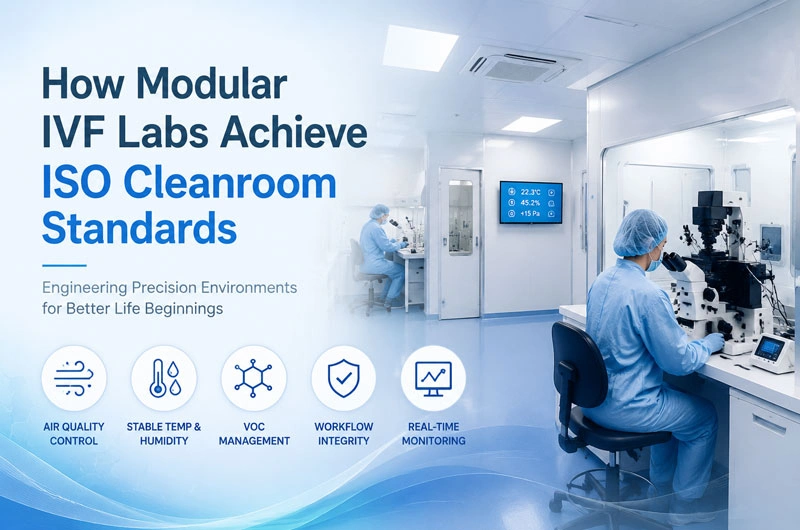
In vitro fertilization (IVF) is one of the most sensitive medical procedures because embryonic development takes place outside the human body. Unlike conventional operating rooms where contamination risks mainly affect patients, IVF laboratories must protect microscopic biological materials that are highly vulnerable to environmental fluctuations.
Many hospitals understand ISO cleanroom standards as simply controlling airborne particles. However, a high-performance modular IVF laboratory requires much more than installing HEPA filters and maintaining positive pressure.
The real challenge is creating a stable, predictable, and biologically optimized environment where temperature, humidity, air quality, vibration, chemical contamination, and workflow are controlled simultaneously.
A well-designed modular IVF lab achieves ISO cleanroom compliance by integrating:
- Cleanroom engineering principles
- Embryology-specific environmental control
- Modular construction technology
- Intelligent monitoring systems
- Optimized laboratory workflow design
1. Understanding ISO Cleanroom Requirements for IVF Laboratories
ISO 14644-1 is the internationally recognized standard for cleanroom classification based on airborne particle concentration.
For IVF laboratories, the commonly applied classification is typically:
| Area | Recommended ISO Classification |
|---|---|
| Embryology Laboratory | ISO Class 7–8 |
| ICSI / Micromanipulation Room | ISO Class 7 |
| Embryo Transfer Preparation Area | ISO Class 7–8 |
| Cryopreservation Area | ISO Class 8 |
However, particle cleanliness is only one part of IVF environmental control.
A laboratory can achieve an excellent particle count but still negatively affect embryo development if:
- VOC levels are uncontrolled
- Temperature fluctuates frequently
- Airflow creates turbulence around workstations
- Materials release chemical emissions
- Personnel movement introduces contamination
Therefore, modern modular IVF labs focus on biological cleanliness rather than only particle cleanliness.
2. Modular Construction Creates a Controlled Cleanroom Envelope
Traditional IVF laboratory construction often involves converting existing hospital rooms. This approach creates hidden challenges:
- Uneven wall surfaces
- Difficult-to-seal joints
- Dust accumulation points
- Limited HVAC integration
- Long construction periods
Modular IVF laboratories solve these problems by creating a factory-engineered cleanroom envelope.
Factory-Manufactured Components
A modular IVF laboratory typically integrates:
- Antibacterial wall panels
- Cleanroom ceiling systems
- Seamless flooring solutions
- Hermetic doors
- Observation windows
- Built-in service panels
These components are manufactured under controlled conditions before installation.
The advantage is that every connection point is designed in advance, reducing:
- Air leakage
- Particle accumulation
- Installation errors
- Future maintenance issues
The cleanroom becomes a complete environmental system rather than simply a renovated room.
3. HVAC Design
Air handling is the heart of ISO compliance.
However, IVF laboratories require a different philosophy compared with general medical cleanrooms.
The objective is not simply to remove particles but to create a stable microenvironment around embryos and laboratory equipment.
A high-performance modular IVF lab usually incorporates:
HEPA Filtration
HEPA filters remove airborne particles and microorganisms by filtering:
- Dust particles
- Skin flakes
- Microbial carriers
- Aerosol contaminants
Typical IVF laboratories use HEPA filtration systems capable of achieving ISO-classified air cleanliness.
Positive Pressure Control
Positive pressure prevents contaminated air from entering when doors open.
The airflow principle is:
Cleaner areas → Less clean areas
For example:
Embryology Laboratory
↓
Preparation Area
↓
Corridor
This pressure cascade reduces contamination migration.
Low-Turbulence Airflow
A common misconception is that higher airflow always means better cleanliness.
In IVF laboratories, excessive airflow can create:
- Temperature instability
- Unnecessary turbulence
- Disturbance near microscopes
- Operator discomfort
Advanced modular IVF labs focus on:
- Uniform airflow distribution
- Stable air velocity
- Reduced turbulence around critical work areas
The goal is not maximum airflow, but controlled airflow where embryos are handled.
4. VOC Control
One of the most overlooked aspects of IVF cleanrooms is chemical contamination.
Volatile Organic Compounds (VOCs) can originate from:
- Paints
- Adhesives
- Flooring materials
- Cleaning agents
- Furniture
- Construction materials
Even very low concentrations of VOCs may affect embryo development because embryos have no mature detoxification mechanisms.
Therefore, modular IVF laboratories select:
- Low-emission materials
- Medical-grade coatings
- Formaldehyde-free panels
- Certified cleanroom materials
This is a major difference between ordinary cleanrooms and IVF-specific environments.
A truly optimized IVF laboratory controls not only what enters the room but also what materials release inside the room.
5. Temperature and Humidity Stability
Embryos require extremely stable environmental conditions.
Temperature fluctuations can affect:
- Culture media stability
- pH balance
- Embryo metabolism
Humidity control influences:
- Static electricity
- Equipment performance
- Operator comfort
- Material behavior
A modular IVF laboratory integrates:
- Precision HVAC systems
- Temperature monitoring
- Humidity sensors
- Alarm systems
The purpose is not simply maintaining a range but minimizing unnecessary fluctuations.
For IVF, stability is often more important than achieving an extreme specification.
6. Workflow Design
Many contamination events are caused by people rather than equipment.
A poorly designed laboratory may have:
- Excessive walking distance
- Frequent door opening
- Cross movement between clean and dirty areas
- Inefficient equipment placement
Modular IVF laboratories improve performance through workflow zoning.
Typical zoning includes:
Personnel Preparation Zone
Controls:
- Clothing change
- Hand hygiene
- Entry procedures
Laboratory Working Zone
Contains:
- IVF workstation
- ICSI workstation
- Microscopes
- Incubators
Material Transfer Zone
Controls:
- Sample movement
- Equipment delivery
- Consumable handling
By separating workflows, modular design reduces unnecessary contamination risks.
7. Real-Time Monitoring
Traditional cleanrooms often rely on periodic testing.
Modern modular IVF laboratories increasingly adopt continuous monitoring systems.
Parameters monitored include:
- Temperature
- Humidity
- Differential pressure
- Particle concentration
- VOC levels
- HVAC status
The advantage is predictive control.
Instead of discovering environmental problems after embryo quality declines, laboratories can identify abnormal trends immediately.
This transforms ISO compliance from a certification requirement into an active quality management system.
8. Why Modular IVF Labs Are Easier to Validate
Validation is a critical step before clinical operation.
Our modular IVF laboratory solution simplifies validation because:
1. Standardized Manufacturing
Components are produced according to predefined specifications.
2. Faster Installation
Less onsite construction means fewer contamination risks.
3. Easier Documentation
Manufacturers can provide:
- Material certificates
- Cleanroom test reports
- HVAC performance data
- Installation records
4. Repeatable Performance
The same modular design can be replicated across multiple hospitals and fertility centers.
This is especially valuable for:
- Multi-site IVF networks
- Developing countries
- Hospitals requiring rapid expansion