
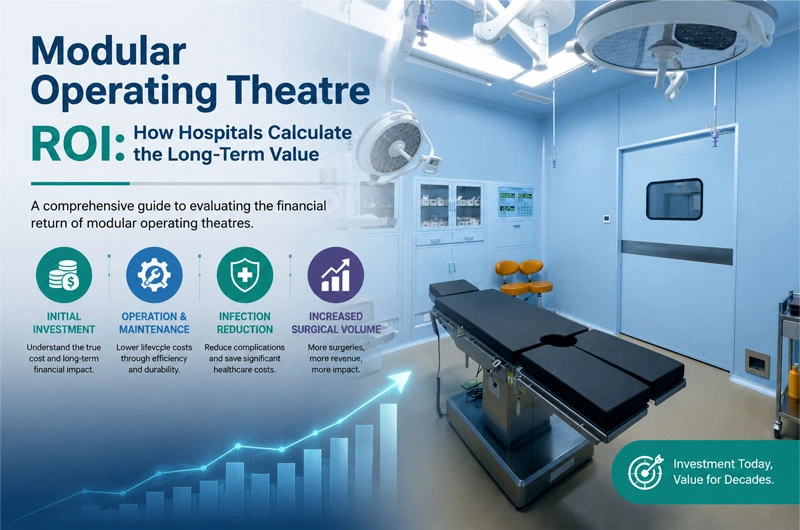
When hospitals consider investing in a modular operating theatre, the first question is often:
“How much does it cost?”
However, experienced healthcare investors ask a different question:
“What long-term value can this operating theatre create?”
Traditional ROI calculations often focus only on the initial investment and ignore hidden economic benefits such as reduced infection-related costs, shorter downtime, and increased surgical throughput.
A more comprehensive MOT ROI model should evaluate four key areas:
- Initial investment
- Operation and maintenance costs
- Economic value created by infection reduction
- Additional revenue from increased surgical volume
1. Initial Investment
The initial investment of a modular operating theatre includes much more than wall panels and installation.
A complete MOT project usually consists of:
1.1 Modular Structure and Cleanroom Components
Major cost components include:
- Antibacterial wall and ceiling panels
- Hermetically sealed doors and windows
- Cleanroom flooring systems
- Laminar airflow ceiling systems
- HEPA filtration systems
- Air conditioning and HVAC integration
- Medical gas systems
- Electrical systems
- Operating room control panels
- Surgical lighting and equipment integration
Compared with conventional operating room renovation, modular OT systems have higher upfront engineering costs but provide a more controlled environment.
1.2 Design and Engineering Costs
Professional MOT projects require:
- Surgical workflow planning
- HVAC simulation
- Airflow analysis
- Infection control design
- Medical equipment positioning
- Electrical and gas planning
A poorly designed operating theatre may create long-term inefficiencies, even if the construction cost is lower.
Therefore, hospitals should evaluate design value rather than simply comparing construction quotations.
1.3 Construction Time Has Economic Value
One overlooked factor is project duration.
A traditional operating room renovation may require:
- Demolition
- Dust control
- Civil construction
- HVAC modification
- Multiple subcontractors
This can lead to several months of operational disruption.
A modular operating theatre can significantly shorten installation time because many components are prefabricated.
For hospitals, every week saved can represent:
- Earlier surgical operations
- Earlier revenue generation
- Reduced impact on existing services
Therefore, ROI should include:
Value of accelerated hospital operation
rather than only construction cost.
2. Operation and Maintenance Costs: The Long-Term Financial Advantage
Many hospitals focus heavily on purchase price but underestimate lifetime operating costs.
A modular operating theatre creates value through predictable maintenance and improved efficiency.
2.1 HVAC Efficiency and Energy Management
The largest operating cost of an operating theatre is often related to:
- Air filtration
- Temperature control
- Humidity control
- Air exchange rates
Modern MOT systems optimize:
- Airflow direction
- Pressure control
- HEPA filtration efficiency
- Energy consumption
A well-designed system can reduce unnecessary air circulation and improve energy efficiency.
Over a 15–20 year lifecycle, energy savings can become a significant part of ROI.
2.2 Reduced Maintenance and Renovation Costs
Traditional operating rooms may require periodic:
- Wall repairs
- Ceiling replacement
- Surface refurbishment
- Waterproofing maintenance
Modular systems use specialized materials designed for healthcare environments:
- Non-porous surfaces
- Antibacterial coatings
- Chemical resistance
- Easy cleaning
This reduces:
- Repair frequency
- Downtime
- Maintenance labor costs
2.3 Reduced Operational Disruption
Operating room downtime has a hidden cost.
For example:
A hospital operating theatre that cannot function for renovation may lose:
- Surgical income
- Patient referrals
- Surgeon availability
- Healthcare reputation
Because modular operating theatres are installed faster, hospitals can reduce revenue interruption.
3. Infection Reduction: Calculating the Hidden Economic Return
One of the most underestimated benefits of modular operating theatres is infection prevention.
Healthcare-associated infections (HAIs) create significant financial burdens:
- Longer patient hospitalization
- Additional medication costs
- Additional surgeries
- Increased nursing workload
- Compensation risks
- Reputation damage
Hospitals can estimate infection-related savings using:
Annual Infection Cost Reduction =
(Number of prevented infections) × (Average cost per infection)
For example:
Assume:
- 1,000 surgeries annually
- Surgical site infection rate reduced by 1%
- Average infection treatment cost: $5,000
The potential annual saving:
1,000 × 1% × $5,000
= $50,000 per year
Over a 15-year operating period:
= $750,000 economic value
This does not include indirect benefits such as:
- Higher patient satisfaction
- Better accreditation performance
- Stronger hospital reputation
4. Increasing Surgical Volume: The Revenue Growth Opportunity
The most direct ROI source for hospitals is often not cost reduction, but increased revenue generation.
A modern operating theatre can improve:
- Surgical scheduling efficiency
- Turnover time between procedures
- Surgeon utilization
- Patient acceptance
4.1 More Available Operating Hours Create More Revenue
Suppose a hospital achieves:
- 2 additional surgeries per week
- Average surgical revenue: $3,000
Additional annual revenue:
2 × 52 × $3,000
= $312,000 per year
Over 10 years:
= $3.12 million additional revenue
4.2 Better Environment Attracts More Medical Services
A high-quality modular operating theatre allows hospitals to expand:
- Orthopedic surgery
- Cardiovascular surgery
- Neurosurgery
- Ophthalmology
- Dental surgery
- Cosmetic surgery
- IVF procedures
For private hospitals especially, operating room quality directly influences:
- Doctor recruitment
- Patient trust
- International patient attraction
5. Example: 15-Year Modular Operating Theatre ROI Scenario
Assume:
Initial Investment
MOT project cost:
$1,500,000
Annual Benefits
Additional surgical revenue:
$300,000/year
Infection reduction savings:
$50,000/year
Energy and maintenance savings:
$50,000/year
Total annual economic benefit:
$400,000/year
15-Year Value
$400,000 × 15 years
= $6,000,000
Investment Return
Total value:
$6 million
Initial investment:
$1.5 million
Potential value creation:
4× investment value