
With the rapid growth of assisted reproductive technology (ART), more hospitals, fertility centers, and private clinics are investing in new IVF laboratories. However, many projects focus primarily on visible elements such as laboratory equipment, interior decoration, or room layout while overlooking the invisible factors that determine IVF success.
Unlike conventional medical laboratories, an IVF laboratory directly interacts with the earliest stages of human life. A small environmental fluctuation—such as unstable temperature, volatile organic compounds (VOCs), poor airflow control, or improper workflow design—can potentially affect embryo development and clinical outcomes.
Therefore, building an IVF laboratory should not be treated as a simple construction project. It requires a comprehensive approach combining embryology requirements, cleanroom engineering, HVAC design, workflow optimization, regulatory compliance, and future scalability.
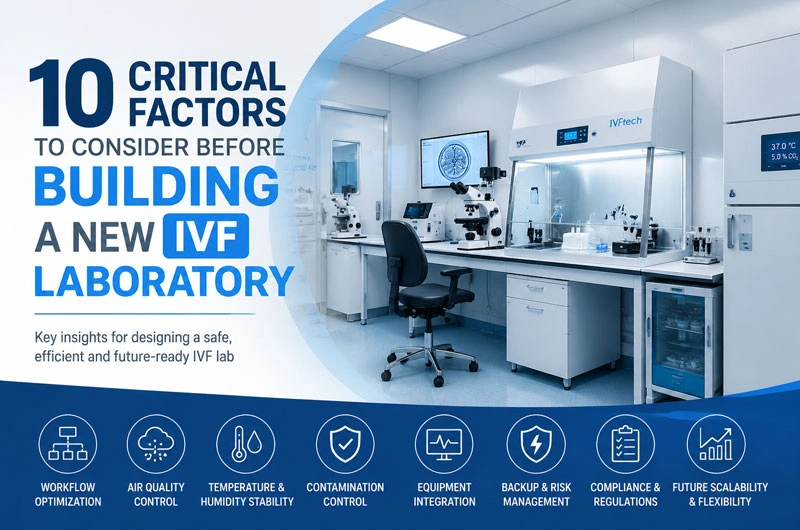
Below are 10 critical factors that should be carefully considered before starting an IVF laboratory construction project.
1. Start With Clinical Workflow, Not Architectural Drawings
One of the most common mistakes in IVF laboratory planning is designing the space before understanding the actual clinical workflow.
A successful IVF laboratory should be designed around the movement of:
- Patients
- Embryologists
- Biological samples
- Medical equipment
- Consumables
- Waste materials
The journey of an oocyte or embryo is extremely time-sensitive. Every unnecessary transfer, door opening, or distance between functional areas increases operational risk.
A well-designed IVF laboratory typically separates different functional zones:
- Oocyte retrieval and handling area
- Andrology laboratory
- Embryology laboratory
- Cryopreservation area
- Media preparation area
- Washing and sterilization area
- Embryo transfer preparation area
The key question is not:
“How many rooms can fit into this space?”
The better question is:
“How can every critical biological process happen with minimum disturbance?”
The best IVF laboratories are workflow-driven rather than building-driven.
2. Location Selection Directly Affects IVF Laboratory Performance
Many owners underestimate the impact of the building location itself.
An IVF laboratory should ideally avoid areas exposed to:
- Heavy traffic pollution
- Industrial emissions
- Construction activities
- High electromagnetic interference
- Excessive vibration
- Poor building infrastructure
Embryos are highly sensitive biological systems. External pollutants can introduce VOCs and airborne contaminants that are difficult to eliminate after the laboratory is completed.
Before construction begins, a professional assessment should evaluate:
- Outdoor air quality
- Building ventilation conditions
- Floor loading capacity
- Power stability
- Backup systems availability
- Elevator and logistics access
A perfect laboratory design cannot fully compensate for a poor building environment.
3. Air Quality Control Is the Core of IVF Laboratory Design
Air quality is arguably the most important factor influencing IVF laboratory performance.
Unlike normal hospital rooms, IVF laboratories require extremely strict control of:
- Particulate matter
- Microbial contamination
- Chemical pollutants
- VOC concentration
Potential contaminants include:
- Cleaning chemicals
- Paint emissions
- Adhesives
- Furniture materials
- Plastic products
- Human activity emissions
A professional IVF laboratory typically requires:
HEPA Filtration
High-efficiency particulate air (HEPA) filters remove airborne particles and microorganisms.
Positive Pressure Environment
Higher air pressure inside the laboratory prevents uncontrolled contaminated air from entering when doors open.
Proper Air Change Rate
Continuous air exchange helps maintain stable environmental conditions.
However, simply increasing air changes does not guarantee better performance.
Excessive airflow may create:
- Temperature instability
- Increased operating costs
- Turbulence around sensitive procedures
The goal is not maximum airflow, but precise airflow control.
4. Temperature and Humidity Stability Matter More Than Average Values
Many laboratory designs focus only on achieving a target temperature range. However, IVF laboratories require stability rather than just acceptable numbers.
For example:
A laboratory maintaining 23°C consistently may perform better than one fluctuating between 20°C and 26°C.
Critical environmental parameters include:
- Temperature stability
- Relative humidity control
- Recovery time after door opening
- Airflow uniformity
Embryo culture systems require extremely stable conditions because sudden environmental changes can influence:
- pH balance
- Gas exchange
- Cellular metabolism
- Embryo development
Therefore, HVAC systems should be designed specifically for IVF applications instead of adapting general hospital air-conditioning systems.
5. Material Selection Directly Influences Embryo Safety
A frequently overlooked issue is the selection of construction materials.
Traditional building materials may release:
- Formaldehyde
- Plasticizers
- Solvent residues
- VOC emissions
These substances can accumulate in controlled environments and negatively affect embryo culture conditions.
Recommended IVF laboratory materials should have:
- Low VOC emissions
- Antibacterial properties
- Smooth surfaces
- Easy cleaning characteristics
- Chemical resistance
Common solutions include:
- Modular cleanroom wall panels
- Medical-grade ceiling systems
- Seamless flooring
- Stainless steel laboratory furniture
The materials surrounding embryos should be considered part of the laboratory’s biological protection system.
6. Laboratory Zoning and Contamination Control Strategy
An IVF laboratory should not be designed as one large clean space.
Different areas have different contamination risks.
A scientific zoning strategy may include:
Higher-Control Areas
- Embryology laboratory
- ICSI workstation
- Culture area
Medium-Control Areas
- Sample preparation
- Andrology laboratory
Supporting Areas
- Storage
- Changing rooms
- Equipment rooms
Effective zoning reduces:
- Cross contamination
- Unnecessary movement
- Cleaning workload
- Operational errors
The best IVF laboratories use architectural design as a contamination-control tool.
7. Equipment Planning Should Happen Before Construction
Another common mistake is purchasing equipment after laboratory construction.
Major IVF equipment affects:
- Electrical requirements
- Space allocation
- Heat load
- Workflow
- Backup power requirements
Important equipment includes:
- CO₂ incubators
- Microscopes
- ICSI systems
- Laminar flow workstations
- Cryogenic storage tanks
- Time-lapse embryo monitoring systems
For example:
A modern time-lapse incubator requires not only physical space but also:
- Network connections
- Stable power supply
- Environmental protection
- Maintenance accessibility
Equipment planning should be integrated into the architectural design stage.
8. Backup Systems Are Essential for Protecting Biological Assets
An IVF laboratory stores irreplaceable biological materials.
A power failure lasting several minutes may cause:
- Incubator temperature fluctuation
- Gas supply interruption
- Cryogenic system risks
Therefore, a reliable IVF laboratory requires:
Power Backup
Including:
- UPS systems
- Emergency generators
- Separate electrical circuits
Gas Backup
Including:
- CO₂ backup supply
- Alarm systems
- Pressure monitoring
Cryogenic Safety
Including:
- Liquid nitrogen monitoring
- Automatic alarms
- Emergency response procedures
A professional IVF laboratory is designed around risk prevention, not only daily operation.
9. Compliance Requirements Should Guide the Design From Day One
Many IVF projects experience expensive modifications because compliance requirements are considered too late.
Depending on the country and region, IVF laboratories may need to comply with:
- Healthcare facility regulations
- Cleanroom standards
- ART accreditation requirements
- Biosafety requirements
- Local construction codes
Early consideration helps avoid:
- Redesign costs
- Construction delays
- Certification problems
A good IVF laboratory supplier should understand both engineering requirements and reproductive medicine workflows.
10. Plan for Future Expansion and Technology Development
An IVF laboratory built today may need to support technologies that become mainstream in the future.
Future considerations include:
- Additional embryo culture capacity
- Genetic testing integration (PGT)
- AI embryo assessment systems
- Automated laboratory systems
- Increased cryopreservation demand
A flexible modular IVF laboratory design provides advantages:
- Faster expansion
- Easier modification
- Lower renovation costs
- Reduced operational disruption
Instead of designing only for today’s requirements, successful fertility centers design for the next 10 years.