
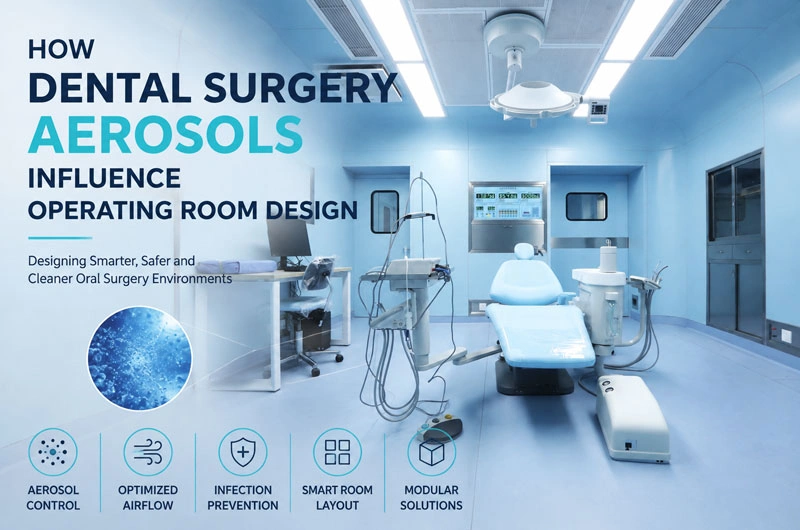
Modern oral surgery has evolved significantly. Procedures such as dental implants, bone grafting, periodontal surgery, and maxillofacial treatments increasingly rely on high-speed instruments, ultrasonic devices, and irrigation systems.
However, these technologies introduce a hidden challenge: aerosol generation.
During dental procedures, high-speed handpieces and ultrasonic scalers can create microscopic droplets and airborne particles containing:
- Saliva residues
- Blood particles
- Microorganisms
- Biological contaminants
- Chemical residues from dental materials
Unlike visible contamination on surfaces, airborne contamination can remain suspended and travel through the operating environment.
This changes a fundamental principle of oral surgery room design:
A dental operating room should not only provide a clean space — it should actively control how contaminated air is generated, moved, filtered, and removed.
Therefore, aerosol behavior has become one of the most important factors influencing the design of modern modular oral surgery operating rooms.
1. Why Dental Aerosols Are Different from Traditional Surgical Contamination
In conventional surgery, contamination control often focuses on:
- Surgical instruments
- Staff movement
- Surface sterilization
- Patient preparation
However, oral surgery introduces a unique contamination pathway: the patient’s oral cavity becomes the source of aerosol generation.
During procedures such as implant placement or tooth extraction:
- The rotating speed of dental instruments can exceed hundreds of thousands of revolutions per minute.
- Cooling water mixes with saliva and tissue debris.
- Aerosols can spread around the patient’s head area.
This creates a localized contamination zone:
Patient mouth → Aerosol generation area → Surgical team breathing zone → Surrounding surfaces
Therefore, oral surgery operating rooms require a different approach compared with standard dental treatment rooms.
The key question is no longer:
“How do we clean the room?”
Instead:
“How do we prevent contaminated air from reaching critical areas in the first place?”
2. Aerosol Behavior Should Determine Operating Room Airflow Design
One of the biggest mistakes in oral surgery room planning is designing airflow based only on room size.
A 30-square-meter room and a 30-square-meter operating room do not have the same airflow requirements.
The reason:
The contamination source is not evenly distributed.
It is concentrated around:
- Patient oral cavity
- Doctor’s working area
- Assistant’s working area
A well-designed modular oral surgery operating room should consider:
Airflow Direction
The ideal airflow strategy creates a controlled movement:
Clean air zone → Surgical field → Contaminated air removal area
This prevents aerosols from moving randomly throughout the room.
Ceiling Supply Air Design
Many advanced modular operating rooms use ceiling-mounted HEPA filtration systems or laminar airflow solutions.
The objective is:
- Deliver clean filtered air directly into the surgical area
- Reduce airborne particle accumulation
- Push contaminants away from critical zones
However, excessive airflow velocity can create another problem:
- Aerosol dispersion
- Patient discomfort
- Disturbance of surgical workflow
Therefore, airflow design requires balance, not simply maximum air volume.
3. The Patient Position Should Influence Room Layout
A unique insight in oral surgery design is:
The dental chair is not just medical equipment — it is the center of the contamination map.
Traditional room planning often places equipment based on available space.
Aerosol-focused design starts from the patient’s position.
The design process should analyze:
- Patient Head Position: Where aerosols are generated.
- Surgeon Working Position: Where exposure risk is highest.
- Assistant Position: Where instrument exchange occurs.
- Air Supply and Return Location: Where contaminants should move.
This approach creates a surgical ecosystem rather than a simple equipment arrangement.
4. Why Return Air Placement Matters in Dental Surgery Rooms
Many operating room designs focus heavily on air supply but underestimate return air positioning.
For oral surgery, return air grilles should support contaminant removal.
Poor placement may cause:
- Aerosols circulating repeatedly
- Increased exposure time
- Contamination of equipment surfaces
A properly designed system should encourage:
Downward or controlled horizontal airflow movement
and quickly remove contaminated air from the surgical zone.
This is especially important for procedures involving:
- Implant surgery
- Periodontal surgery
- Long-duration operations
5. Surface Materials Are Also Part of Aerosol Control
Aerosols do not only remain in the air.
Particles eventually deposit on:
- Walls
- Ceilings
- Equipment surfaces
- Cabinets
Therefore, modular oral surgery operating rooms should consider:
Seamless Wall Systems
Traditional painted walls may contain:
- Cracks
- Joints
- Uneven surfaces
Modular surgical wall systems typically use:
- Smooth panels
- Sealed joints
- Easy-clean surfaces
Rounded Corners
Large-radius or coved corners reduce:
- Dust accumulation
- Cleaning difficulty
- Microbial hiding areas
Antibacterial Materials
Surface materials with antibacterial properties provide an additional layer of protection.
The goal is not only removing airborne contaminants but also reducing contamination retention.
6. Ventilation Design Must Support Surgical Workflow
A common misunderstanding is:
“More air changes always mean better infection control.”
However, operating room performance depends on the entire system:
- Airflow pattern
- Filtration efficiency
- Room pressure
- Equipment arrangement
- Door opening frequency
For example:
A poorly designed room with high airflow but incorrect air direction may spread aerosols faster.
A properly designed modular operating room achieves:
- Controlled airflow
- Stable pressure conditions
- Reduced contamination movement
7. Door Design and Human Movement Are Part of Aerosol Management
Every door opening creates air exchange.
In oral surgery environments, frequent movement can disturb airflow patterns.
Therefore, design considerations include:
- Automatic sliding doors
- Proper entrance location
- Separate preparation areas
- Staff workflow planning
Aerosol control is not only an HVAC issue.
It is also a human behavior issue.
8. Why Modular Oral Surgery Operating Rooms Are Better Suited for Aerosol Control
Compared with traditional construction, modular operating rooms provide several advantages:
Factory-Controlled Manufacturing
Components are manufactured under controlled conditions.
Benefits:
- Accurate dimensions
- Better sealing
- Reduced installation errors
Integrated System Design
A modular solution allows coordination between:
- Wall panels
- Ceiling systems
- HVAC
- Lighting
- Medical gases
- Electrical systems
This prevents different contractors from creating incompatible systems.
Faster Validation and Maintenance
Because modular systems use standardized components:
- Performance testing is easier
- Maintenance is simplified
- Future expansion is possible
Conclusion
Dental surgery aerosols have fundamentally changed how oral surgery environments should be designed.
A modern oral surgery operating room is no longer simply a clean room with medical equipment.
It is an integrated system where:
- Airflow controls contamination movement
- Layout reduces exposure risk
- Materials support hygiene management
- Modular construction ensures reliable performance
For hospitals, dental centers, and healthcare investors, the most effective infection-control strategy begins not after contamination occurs, but at the design stage.
By considering aerosol behavior from the beginning, modular oral surgery operating rooms can provide safer surgical environments, improve operational efficiency, and support the future development of advanced dental healthcare facilities.