
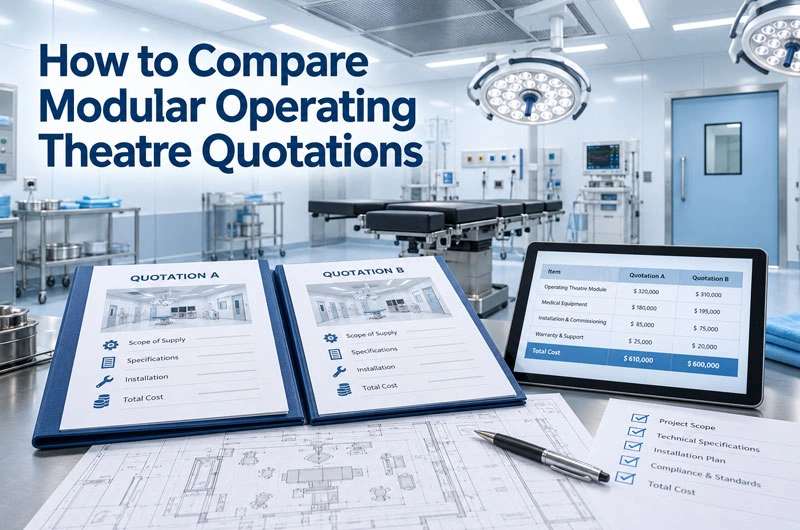
Two modular operating theatre quotations can describe the same number of rooms and still cover very different projects.
One may include wall panels, doors, and basic accessories. Another may also cover ventilation equipment, installation, testing, staff training, and documentation. Even when both suppliers use the word “turnkey,” their responsibilities may differ.
To compare modular operating theatre quotations fairly, hospitals should first confirm equivalent technical specifications and delivery scope, then calculate the total cost of completing and handing over the project.
Start with the Same Project Brief
A meaningful comparison begins before suppliers submit their prices.
Give each bidder the same drawings, room schedule, equipment requirements, and project assumptions. Ask suppliers to identify any deviations explicitly.
Your request for quotation should include:
- Project location and whether it involves new construction or renovation.
- Number, intended use, dimensions, and ceiling height of each room.
- Available architectural drawings and existing building services.
- Required materials, equipment, and interfaces.
- Applicable project standards and acceptance requirements.
- Expected installation responsibilities and delivery schedule.
- Required training, documentation, warranty, and maintenance support.
If the design is still preliminary, ask suppliers to list their assumptions and provide unit rates for likely changes. A provisional price should be clearly distinguished from a fixed price based on approved drawings.
A Modular Operating Theatre Quotation Comparison Table
Use the following checklist to request a consistent response from each supplier.
For every line, record Included, Excluded, Optional, or Clarification Required, together with the specification, quantity, responsible party, and price where applicable. A blank entry should remain unresolved until the supplier confirms it.
| Comparison item | Details to confirm | Differences that can affect the final cost |
|---|---|---|
| Design and engineering | Site survey, layout drawings, coordination drawings, calculations, revision allowance | Preliminary layout only versus coordinated construction documentation |
| Wall and ceiling systems | Material grade, face-sheet thickness, total panel thickness, core, finish, joints, quantities | Similar-looking panels may have different construction and supporting test evidence |
| Flooring | Material, thickness, substrate preparation, coving, joints, installation | Floor covering may be included while leveling or substrate repairs are excluded |
| Doors and windows | Dimensions, opening type, seals, controls, sensors, glazing, quantity | A basic automatic door differs from a specified and tested hermetic door assembly |
| HVAC system | Air-handling equipment, filters, ductwork, insulation, controls, connections | A laminar flow ceiling may be quoted without the complete air-handling system |
| Electrical and controls | Distribution, wiring, outlets, lighting, sensors, alarms, integration | Control-panel supply may exclude field wiring, sensors, or building-system integration |
| Medical gas services | Outlets, pipework, valves, alarms, source connections, testing | Terminal outlets may be included while the distribution network is excluded |
| Clinical equipment | Surgical lights, tables, pendants, monitors and other scheduled equipment | “Complete OT” may refer only to the room enclosure and supporting infrastructure |
| Cabinets and accessories | Dimensions, material grades, fittings, quantities, installation | Standard accessories may differ from the hospital’s required configuration |
| Packing and delivery | Export packing, freight, insurance, customs responsibilities, unloading | Factory supply, port delivery, and delivery to the hospital have different cost boundaries |
| Installation | Labor, supervision, tools, lifting equipment, consumables, site connections | Remote guidance, on-site supervision, and full installation are different services |
| Testing and commissioning | Test plan, acceptance criteria, competent personnel, reports, retesting | Equipment startup may exclude system performance testing and independent verification |
| Training and handover | Operator training, maintenance training, manuals, as-built drawings | Basic instruction may exclude detailed training and final project records |
| Warranty and after-sales | Coverage, start date, labor, travel, freight, response terms, exclusions | Replacement parts may be covered while replacement labor and transport are not |
| Commercial conditions | Currency, taxes, payment milestones, validity, change rates, schedule assumptions | A lower initial price may depend on narrower scope or different payment conditions |
1. Compare Materials Beyond Their Names
Descriptions such as “antibacterial panel,” “stainless steel,” or “fire-resistant wall system” are not detailed enough for a purchasing decision.
For wall and ceiling panels, request the complete construction specification: exposed surface, material grade, face-sheet thickness, core composition, total thickness, coating, edge treatment, and connection details.
Distinguish between face-sheet thickness and overall panel thickness. These describe different characteristics and should appear separately in the quotation.
For performance claims, ask for documentation identifying:
- The tested product or assembly.
- The test method or standard.
- The result and its applicable conditions.
- Whether the proposed construction matches the tested configuration.
Also confirm compatibility with the hospital’s cleaning products and procedures. A finish should be evaluated for its intended use, maintenance requirements, and repair options.
Compare installed quantities carefully. Wall area, ceiling area, openings, corners, support structures, and joint accessories should follow the same measurement basis across bids.
2. Check Equipment Models, Quantities, and Interfaces
Equipment descriptions should identify the manufacturer, model, quantity, technical specification, and included accessories.
Where substitutions are proposed, require a documented comparison and an approval process.
Pay particular attention to system boundaries. For example:
- A laminar flow ceiling does not establish that an air-handling unit, ductwork, controls, and balancing are included.
- A medical gas outlet does not establish that pipework, valves, alarms, and testing are included.
- A control panel does not establish that sensors, field wiring, and integration are included.
- A room package does not establish that surgical tables, lights, or anesthesia equipment are included.
Ask each supplier to mark its scope on a drawing or system diagram. This helps expose gaps between the modular room supplier and the hospital’s other contractors.
3. Define Exactly What “Installation Included” Means
Installation services can take several forms.
| Installation arrangement | Typical supplier role | Hospital responsibilities to clarify |
|---|---|---|
| Supply with remote guidance | Provides instructions, drawings, and remote technical assistance | Local installers, supervision, tools, site coordination, and testing arrangements |
| On-site supervision | Sends a specialist to guide or inspect local installation | Local labor, equipment, working access, and the supervisor’s expenses where excluded |
| Full installation within a defined scope | Provides installation personnel for specified systems | Site readiness, utilities, other contractors’ work, and excluded connections |
These descriptions are starting points. The quotation should state the actual responsibilities.
For international projects, clarify who pays for travel, visas, accommodation, local transport, lifting equipment, and additional visits. Ask how delays caused by an unprepared site will be handled.
Request a site-readiness checklist before accepting the installation schedule. Production completion, delivery, installation completion, and handover are separate milestones.
4. Separate Startup, Commissioning, and Acceptance
Switching equipment on is only one step toward demonstrating that a completed operating theatre meets its agreed requirements.
Ask the supplier to define the proposed testing and commissioning process, including:
- Systems and functions to be tested.
- Measurable acceptance criteria.
- Required test conditions.
- Who performs and witnesses the tests.
- Which reports and certificates will be delivered.
- Responsibility for correcting defects and repeating failed tests.
Depending on the approved project requirements, the scope may include ventilation measurements, pressure relationships, environmental controls, alarms, door functions, electrical checks, and medical gas verification.
Factory checks can provide useful evidence, but the quotation should also address performance after installation and connection to the hospital’s systems.
5. Compare Warranty and After-Sales Support in Detail
A warranty period alone does not explain the protection offered.
Two suppliers may both offer a twelve-month warranty while covering different costs and services. Ask:
- When does coverage begin: shipment, delivery, installation, or acceptance?
- Which components and types of failure are covered?
- Are diagnosis, replacement labor, travel, and freight included?
- Which consumables and maintenance activities are excluded?
- How are third-party equipment warranties handled?
- What remote and on-site support is available?
- How long are replacement parts expected to remain available?
Distinguish a promised response time from a repair or resolution time. Acknowledging a fault does not mean that a technician or replacement component will arrive within the same period.
Request a recommended spare-parts list, indicative prices, and a maintenance schedule. These make ongoing support easier to compare.
6. Calculate the Cost of an Equivalent Completed Scope
Before comparing totals, bring each bid onto the same scope, currency, tax basis, and pricing date.
A useful approach is:
Evaluated project cost = quoted price + required excluded work + delivery and site costs + required options − confirmed duplicate allowances.
Keep uncertain costs visible as provisional allowances. Do not treat an unresolved exclusion as zero.
The following example shows why this matters.
Illustrative figures only—these are not market prices or an Eucalyptus quotation. All amounts are USD, with taxes excluded consistently.
| Cost item | Supplier A | Supplier B |
|---|---|---|
| Base quotation | $100,000 | $120,000 |
| Required HVAC scope excluded from base | $15,000 | Included |
| Installation labor excluded from base | $10,000 | Included |
| Required commissioning and reports | $5,000 | Included |
| Freight and site handling | $8,000 | $8,000 |
| Evaluated cost for equivalent scope | $138,000 | $128,000 |
Supplier A’s initial quotation is lower, but Supplier B’s evaluated cost is lower after the identified scope differences are priced.
This comparison is valid only if both offers meet equivalent technical and acceptance requirements.
7. Resolve Clarifications Before Awarding the Contract
Create a clarification register and ask each supplier to issue a revised quotation incorporating its final answers.
Before approval, confirm that:
- All bidders have priced the same drawing revision and room schedule.
- Materials, equipment models, and quantities are identified.
- Exclusions and optional items are explicitly listed.
- Installation boundaries and site responsibilities are agreed.
- Testing, acceptance, and handover deliverables are defined.
- Warranty coverage and support terms are documented.
- Payment milestones correspond to verifiable deliverables.
- Changes require written scope and price approval.
- Delivery commitments identify their starting conditions and dependencies.
Resolve essential technical requirements before ranking suppliers by price. A cheaper offer that does not satisfy the hospital’s needs is not an equivalent alternative.
Preparing a Clear Quotation Request with Eucalyptus
Eucalyptus provides modular operating theatre design, manufacturing, installation, and supporting technical services.
To request a project-specific quotation, share your floor plans, room dimensions, intended surgical applications, installation location, required equipment, and preferred division of responsibilities. Identify whether you need component supply, installation guidance, or a broader project package.
A clearly defined brief makes it easier to obtain a quotation that your hospital can evaluate, clarify, and approve with confidence.
Contact Eucalyptus to discuss your modular operating theatre project.