
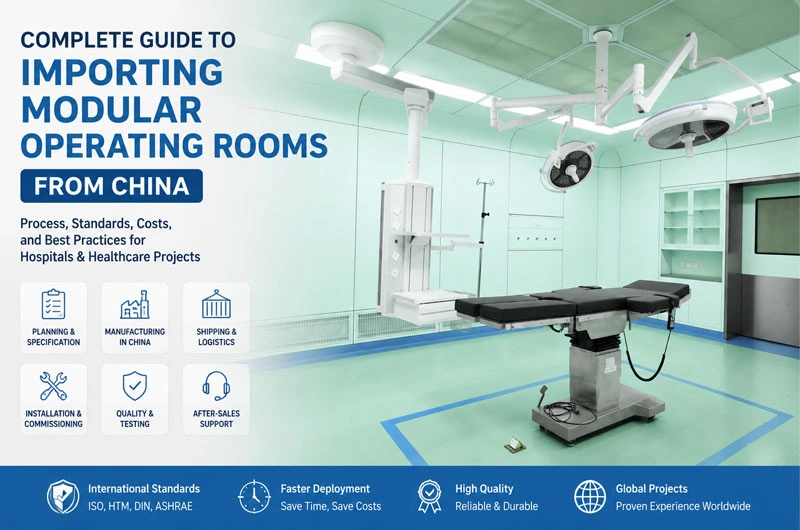
Over the past decade, modular operating rooms have evolved from a niche solution into a mainstream choice for hospitals seeking faster construction, better infection control, and international-standard surgical environments.
For many developing countries, private hospitals, and healthcare expansion projects, importing a modular operating room from China has become an attractive alternative to traditional construction.
The reason is simple:
A conventional operating theatre often requires months of civil works, multiple contractors, complex coordination, and unpredictable costs. A modular operating room, however, can be designed, manufactured, tested, shipped, and installed as an integrated medical environment.
However, importing an MOT is not simply a matter of purchasing wall panels and equipment.
A successful project requires understanding:
- How to select the right manufacturer
- How to define technical specifications
- How to manage international logistics
- How to coordinate installation overseas
- How to avoid hidden costs and project delays
This guide provides a complete framework based on real-world project experience.
1. Understanding What You Are Actually Importing
Many buyers misunderstand modular operating rooms as a “prefabricated room.”
In reality, you are importing a complete surgical infrastructure system.
A professional modular operating theatre usually includes:
1. Architectural System
- Antibacterial wall panels
- Ceiling systems
- Flooring solutions
- Hermetic sliding doors
- Observation windows
- Equipment cabinets
- Scrub stations
- Storage systems
2. HVAC and Air Purification System
The HVAC system is the core of operating room performance.
It includes:
- HEPA filtration
- Laminar airflow ceiling
- Air supply units
- Return air grilles
- Positive pressure control
- Temperature and humidity control
3. Medical Engineering System
Including:
- Medical gas pipeline
- Electrical distribution
- Operating room control panels
- Lighting systems
- Communication systems
- Nurse calling systems
4. Validation and Testing
A professional supplier should provide:
- Air cleanliness testing
- Air velocity testing
- Pressure difference testing
- Temperature and humidity testing
- HEPA integrity testing
Therefore, importing an MOT is closer to importing a medical cleanroom ecosystem rather than a construction product.
2. Why China Has Become a Major Source for Modular Operating Rooms
China has developed a strong manufacturing ecosystem for modular healthcare infrastructure.
The advantages include:
2.1 Integrated Manufacturing Capability
Many Chinese MOT manufacturers can provide:
Design → Manufacturing → Shipping → Installation → Commissioning
This reduces coordination problems between multiple suppliers.
For hospitals, this means:
- One responsible party
- Faster communication
- Lower project management complexity
2.2 Cost Advantage Without Sacrificing Standards
Compared with suppliers from Europe or North America, Chinese manufacturers often offer:
- Competitive manufacturing costs
- Flexible customization
- Faster production cycles
However, the lowest price is not always the best choice.
A cheaper MOT may use:
- Lower-grade panels
- Poor sealing systems
- Inadequate HVAC design
- Limited overseas support
The real question is not:
“Which supplier offers the lowest price?”
The better question is:
“Which supplier provides the lowest lifetime operating cost?”
3. Selecting the Right Modular Operating Room Manufacturer in China
Choosing a supplier is the most critical decision.
3.1 Evaluate Manufacturing Capability
Before cooperation, buyers should check:
Factory Capability
Ask:
- Does the company manufacture panels themselves?
- Do they have CNC cutting equipment?
- Do they produce doors and accessories internally?
- Do they have quality control procedures?
A trading company may provide attractive prices but often lacks engineering capability.
3.2 Check Previous Overseas Projects
Domestic projects and international projects are different.
Overseas experience means the supplier understands:
- Export packaging
- International electrical standards
- Local construction conditions
- Installation coordination
- Customs requirements
Ask suppliers:
- Which countries have you installed projects?
- Can you provide project photos?
- Can you provide client references?
3.3 Evaluate Engineering Ability
An MOT is not only a product.
It requires engineering calculation.
A capable supplier should understand:
- Operating room classification
- Air change rate requirements
- Pressure cascade design
- HVAC load calculation
- Medical gas planning
A manufacturer without engineering capability may only provide drawings, not solutions.
4. Defining Technical Specifications Before Ordering
One of the biggest mistakes buyers make is requesting quotations too early.
A vague inquiry like:
“Please quote a modular operating room.”
usually creates inaccurate pricing.
Before requesting quotations, prepare:
1. Operating Room Type
Examples:
- General surgery OR
- Orthopedic OR
- Cardiac OR
- Neurosurgery OR
- Hybrid OR
- IVF laboratory
- Dental operating room
Different applications require different designs.
2. Room Size
Example:
- Main OR: 45 m²
- Preparation room: 15 m²
- Scrub area: 8 m²
3. Cleanliness Requirement
Examples:
- ISO Class 5
- ISO Class 7
4. HVAC Requirements
Define:
- Air changes per hour
- Temperature range
- Humidity range
- Pressure requirement
5. Local Standards
Confirm whether the project follows:
- HTM standards
- DIN standards
- ISO standards
- ASHRAE guidelines
- Local healthcare regulations
5. Understanding the Import Process Step by Step
Step 1: Initial Consultation
The supplier should review:
- Hospital layout
- Clinical workflow
- Medical requirements
A good supplier does not immediately sell products.
They ask:
- What surgeries will be performed?
- How many operations per day?
- What equipment will be installed?
- How will doctors and nurses move?
Step 2: Engineering Design
The supplier prepares:
- Floor plans
- Ceiling plans
- HVAC layouts
- Electrical drawings
- Medical gas drawings
This stage determines project success.
Step 3: Factory Production
Production usually includes:
- Panel manufacturing
- Door fabrication
- Cabinet production
- Electrical assembly
- Quality inspection
Professional manufacturers often conduct pre-shipment inspections.
Step 4: International Shipping
Major considerations:
Packaging
Operating room components must be protected from:
- Moisture
- Impact
- Long-distance transportation
Container Planning
A common mistake is underestimating shipping volume.
The supplier should provide:
- Packing list
- Container loading plan
- Shipping documents
Step 5: Overseas Installation
Installation is where many projects fail.
Problems often include:
- Local workers unfamiliar with MOT systems
- Building conditions not matching drawings
- Electrical differences
- HVAC connection issues
A professional supplier should provide:
- Installation drawings
- Site supervision
- Commissioning support
6. Hidden Costs That Buyers Often Ignore
The equipment price is only part of the total investment.
A realistic budget should include:
1. Engineering Cost
Including:
- Design
- Drawings
- Technical consultation
2. Logistics Cost
Including:
- Sea freight
- Insurance
- Customs clearance
- Local transportation
3. Installation Cost
Including:
- Engineer travel
- Accommodation
- Local labor
4. Supporting Infrastructure
The hospital may need:
- HVAC connection
- Generator capacity
- Water supply
- Drainage
- External medical gas system
7. Common Mistakes When Importing MOTs from China
Mistake 1: Choosing Based Only on Price
A low quotation may exclude:
- Testing
- Installation support
- Engineering drawings
- After-sales service
Always compare the complete solution.
Mistake 2: Ignoring Local Installation Conditions
A modular operating room must fit the existing building.
Before production, confirm:
- Floor level
- Ceiling height
- Structural conditions
- Access routes
Mistake 3: Not Confirming Responsibilities
The contract should clearly define:
Supplier responsibility:
- Design
- Manufacturing
- Installation
- Testing
Client responsibility:
- Civil preparation
- Utilities connection
- Local approvals
Mistake 4: Treating MOT as a Construction Project
A traditional contractor mindset often creates problems.
An operating room requires:
- Healthcare knowledge
- Infection control understanding
- Cleanroom engineering
8. How to Reduce Risk When Working with Chinese MOT Suppliers
A practical strategy is:
Phase 1: Supplier Verification
Check:
- Factory videos
- Certifications
- Previous projects
- Engineering team
Phase 2: Prototype and Sample Review
For large projects, request:
- Panel samples
- Door samples
- Material specifications
Phase 3: Technical Approval
Before production:
Confirm:
- Drawings
- Material specifications
- Equipment list
- Testing standards
Phase 4: Installation Planning
Before shipment:
Prepare:
- Installation schedule
- Site requirements
- Local workforce plan
9. Future Trend: Modular Operating Rooms as Healthcare Infrastructure
The future of healthcare construction is moving toward:
- Faster deployment
- Standardized quality
- Flexible expansion
- Digital monitoring
For developing regions especially, modular operating rooms provide an opportunity to build international-standard surgical facilities without traditional construction limitations.
Hospitals can:
- Expand capacity faster
- Improve infection control
- Reduce construction disruption
- Upgrade healthcare services
Conclusion
Importing a modular operating room from China is not simply purchasing equipment.
It is selecting a long-term engineering partner.
The best suppliers combine:
- Manufacturing capability
- Medical engineering knowledge
- International project experience
- Installation support
- Quality control systems
For hospitals planning overseas healthcare projects, the key is not finding the cheapest modular operating room.
The key is finding a supplier who can successfully transform a design concept into a fully operational surgical environment.
A well-designed modular operating room can become the foundation for safer surgeries, better infection control, and long-term healthcare development.