
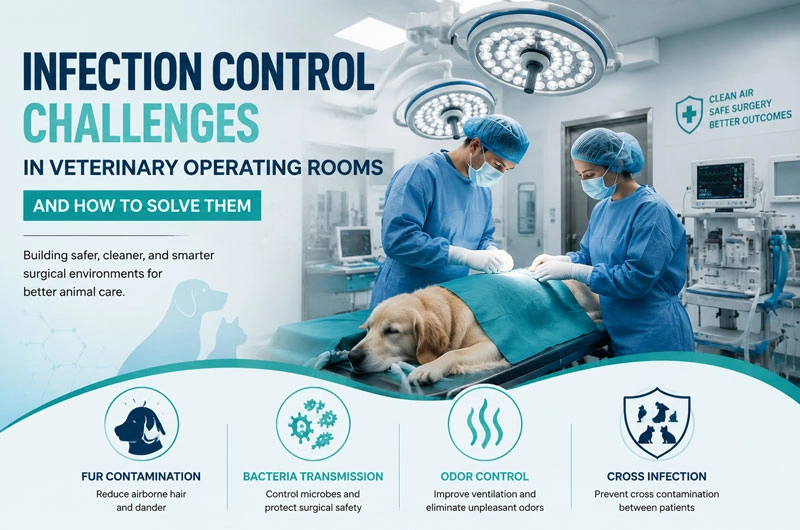
Veterinary operating rooms face many of the same infection control challenges as human surgical facilities, but they also have unique biological and environmental risks.
Unlike human hospitals, veterinary surgical environments must manage multiple species, different coat types, unpredictable animal behavior, and higher levels of organic contamination. A dog undergoing orthopedic surgery, a cat receiving soft tissue surgery, and an exotic animal procedure may introduce completely different microbial and environmental challenges.
Many veterinary hospitals focus heavily on surgical instruments and sterilization protocols, but overlook another critical factor:
The operating room itself is an infection control system.
Airflow design, room pressure, surface materials, zoning, ventilation, and cleaning efficiency directly influence whether contaminants remain controlled or circulate throughout the surgical environment.
This article explores the four major infection control challenges in veterinary operating rooms — fur contamination, bacteria transmission, odor control, and cross infection — and provides practical solutions from an operating room design perspective.
1. Fur Contamination
The Challenge
Fur is one of the most distinctive contamination sources in veterinary surgery.
Compared with human patients, animals naturally carry:
- Loose hair and fur particles
- Skin flakes
- Environmental dust trapped in coats
- External microorganisms attached to hair surfaces
During preparation, positioning, and surgical procedures, fur particles can easily become airborne.
A common misconception is that fur contamination is only a cleanliness issue. In reality, fur can act as a microbial carrier.
A single floating hair particle may carry:
- Staphylococcus species
- Environmental bacteria
- Fungal spores
- Organic residues
When these particles settle on sterile instruments, surgical fields, or implants, they may increase the risk of surgical site infections.
Solution
Traditional cleaning methods focus on removing visible fur after surgery. However, the more effective approach is preventing airborne circulation.
1. High-Efficiency Air Filtration
Veterinary operating rooms should incorporate:
- HEPA filtration systems
- Controlled air exchange rates
- Laminar airflow solutions for high-risk procedures
HEPA filtration helps capture airborne particles before they settle onto sterile areas.
2. Positive Pressure Operating Rooms
Maintaining positive pressure ensures that clean filtered air flows outward when doors open, preventing contaminated air from entering the surgical environment.
This is especially important because veterinary facilities often experience frequent door movement due to:
- Animal transportation
- Staff circulation
- Equipment movement
3. Easy-to-Clean Interior Materials
Wall and ceiling systems should minimize:
- Dust accumulation
- Hair attachment
- Microbial growth
Seamless antibacterial panels and sealed joints reduce areas where fur and microorganisms can remain hidden.
2. Bacteria Transmission
The Challenge
Veterinary patients introduce complex bacterial environments.
Animals may carry microorganisms from:
- Outdoor environments
- Kennels
- Farms
- Previous medical facilities
- Other animals
Some bacteria may exist without visible symptoms but can still contaminate surgical environments.
Common transmission routes include:
Animal → Environment
Microorganisms transfer from:
- Skin
- Fur
- Body fluids
- Respiratory secretions
to:
- Surgical tables
- Floors
- Equipment surfaces
Environment → Animal
Contaminated surfaces, instruments, or airflow can introduce pathogens into surgical wounds.
Solution
Effective infection control requires more than cleaning. It requires environmental separation.
1. Zoning Design
A veterinary operating facility should separate:
Clean Zones
- Sterile storage
- Instrument preparation
- Operating rooms
Semi-Clean Zones
- Preparation areas
- Anesthesia areas
Contaminated Zones
- Animal receiving
- Recovery areas
- Waste handling
Poor zoning allows microorganisms to travel freely between different spaces.
Antibacterial Surfaces
Modern modular veterinary operating rooms can integrate:
- Antibacterial wall panels
- Hygienic ceiling systems
- Seamless flooring
- Rounded corners
These designs reduce microbial hiding points and simplify daily disinfection.
Optimized Airflow Direction
Air should move from cleaner areas toward less clean areas.
A properly designed airflow system helps:
- Remove airborne contaminants
- Reduce bacterial concentration
- Maintain sterile conditions around the surgical field
3. Odor Control
The Challenge
Odor is often underestimated in veterinary surgical environments.
Animal-related odors come from:
- Fur oils
- Urine and fecal contamination
- Wound drainage
- Anesthesia gases
- Cleaning chemicals
While odor itself may not directly cause infection, it often indicates the presence of airborne organic compounds and insufficient ventilation.
Poor odor control can lead to:
- Unpleasant working environments
- Staff discomfort
- Reduced client confidence
- Potential accumulation of contaminants
Solution
1. Increased Ventilation Efficiency
Veterinary operating rooms require carefully designed ventilation systems to remove:
- Odor molecules
- Aerosols
- Volatile organic compounds (VOCs)
Air exchange should be designed according to:
- Procedure type
- Room size
- Animal volume
- Surgical risk level
Dedicated Exhaust Systems
Areas with higher odor risks should have independent ventilation solutions:
- Animal preparation rooms
- Recovery rooms
- Isolation areas
This prevents odors and contaminants from spreading into sterile zones.
Low-Absorption Materials
Traditional porous materials can absorb:
- Odors
- Moisture
- Organic contaminants
Modular veterinary operating rooms use non-porous surfaces that allow:
- Faster cleaning
- Better disinfection
- Reduced odor retention
4. Cross Infection
The Challenge
Veterinary hospitals treat multiple species in the same facility:
- Dogs
- Cats
- Rabbits
- Birds
- Exotic animals
Each species may carry different microorganisms.
A surgical environment that is safe for one patient may not be suitable for another if contamination control is insufficient.
Cross infection can occur through:
- Shared equipment
- Staff movement
- Air circulation
- Poorly designed recovery areas
Solution
1. Dedicated Surgical Pathways
The movement of:
- Animals
- Surgeons
- Nurses
- Equipment
- Waste
should follow controlled pathways.
The goal is to avoid:
Dirty → Clean → Sterile
movement patterns.
5. Infection Control Starts Before Surgery Begins
Many veterinary hospitals consider infection control as a cleaning task after surgery.
However, the most effective infection prevention strategy begins much earlier:
At the moment air enters the operating room.
A well-designed veterinary operating room controls:
- What enters
- What circulates
- What remains
- What leaves
By combining airflow management, hygienic materials, zoning design, and modular construction, veterinary hospitals can significantly reduce infection risks while improving surgical safety.