
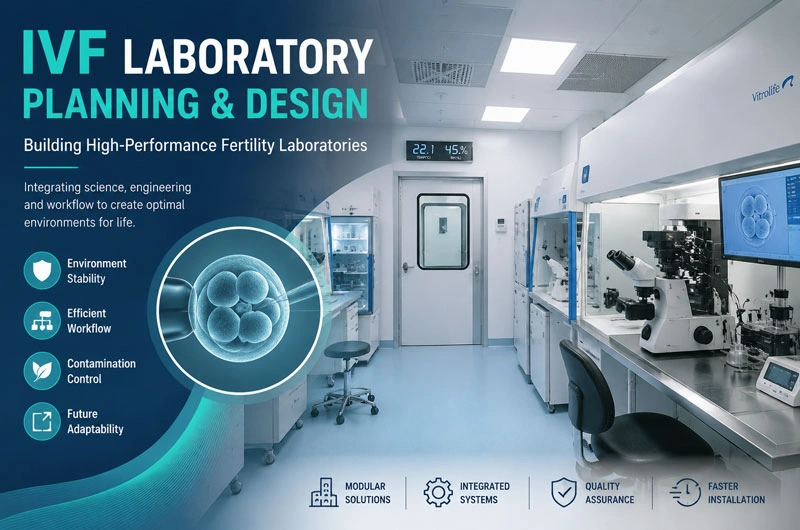
In-vitro fertilization (IVF) laboratories are among the most sensitive medical environments to design. Unlike conventional clinical spaces, an IVF laboratory is not only a workplace for embryologists but also a controlled biological ecosystem where environmental stability directly influences embryo development, fertilization outcomes, and ultimately pregnancy success rates.
Many IVF laboratory projects focus primarily on equipment selection and room construction. However, the real challenge lies in creating a system where architecture, airflow, temperature control, laboratory workflow, contamination prevention, and embryology requirements work together as one integrated environment.
A well-designed IVF laboratory is not simply a cleanroom. It is a precision-controlled life-support system for embryos.
1. IVF Laboratory Design Starts With Understanding Embryo Sensitivity
Embryos are extremely vulnerable during their early developmental stages. Unlike manufactured products that can tolerate environmental fluctuations, embryos respond immediately to small changes in their surroundings.
Critical environmental factors include:
- Temperature fluctuations
- Airborne contaminants
- Volatile organic compounds (VOCs)
- pH changes in culture media
- Air pressure variations
- Human movement and workflow errors
Even when the laboratory meets general cleanroom requirements, poor planning can still create risks.
For example:
- A frequently opened door can introduce chemical contaminants.
- Improper personnel circulation can increase microbial load.
- Poor equipment placement can cause unnecessary movement around embryo workstations.
- Incorrect HVAC design can create unstable temperature conditions.
Therefore, IVF laboratory planning should begin with one question:
How can we create the most stable environment for embryo development?
2. Functional Zoning
A common mistake in IVF laboratory design is starting with room dimensions instead of workflow analysis.
A successful IVF laboratory should follow the natural process of assisted reproductive procedures.
A typical IVF laboratory includes:
2.1 Embryology Laboratory
The embryology laboratory is the core area where sensitive procedures occur:
- Oocyte handling
- Sperm preparation
- Fertilization procedures
- Embryo culture
- Embryo evaluation
- Cryopreservation preparation
This area requires the highest environmental control.
Key considerations:
- Stable temperature
- Low particle concentration
- Minimal personnel movement
- Controlled access
- Low VOC environment
2.2 Andrology Laboratory
The andrology laboratory handles:
- Semen analysis
- Sperm preparation
- Quality assessment
It should be strategically positioned near the embryology area to reduce transportation time while maintaining workflow separation.
A poorly planned layout may increase:
- Sample transfer distance
- Identification risks
- Staff movement
2.3 Cryopreservation Area
Cryopreservation requires dedicated planning for:
- Liquid nitrogen storage
- Ventilation safety
- Cylinder management
- Temperature monitoring
A common design mistake is placing cryogenic storage in a confined room without sufficient oxygen monitoring.
Because liquid nitrogen can displace oxygen, safety planning is essential.
2.4 Media Preparation Area
Culture media preparation requires:
- Low contamination risk
- Stable environmental conditions
- Controlled storage
- Dedicated workspace
This area should avoid unnecessary traffic from general laboratory activities.
3. HVAC Design
In IVF laboratories, HVAC is more than temperature control.
It directly affects:
- Air cleanliness
- Embryo safety
- Operator comfort
- Contamination control
A professional IVF HVAC system typically includes:
HEPA Filtration
High-efficiency particulate air (HEPA) filters remove airborne particles that may carry microorganisms or contaminants.
Common configurations include:
- HEPA terminal filtration
- Ceiling-mounted filtration systems
- Laminar airflow solutions
Positive Pressure Control
IVF laboratories generally maintain positive pressure compared with surrounding areas.
The principle is simple:
When doors open, clean filtered air flows outward rather than allowing contaminated air to enter.
This reduces:
- Particle infiltration
- Microbial contamination
- Environmental instability
Temperature and Humidity Stability
Embryo culture requires extremely stable environmental conditions.
Typical design targets:
- Temperature: approximately 20–24°C
- Relative humidity: 40–60%
However, the goal is not only maintaining a set value.
The more important factor is:
Reducing fluctuations.
A laboratory that stays at 22°C continuously is usually better than one fluctuating between 20°C and 24°C.
4. VOC Control
Many IVF laboratory failures are not caused by visible contamination.
They are caused by invisible chemical contaminants.
Potential VOC sources include:
- Paints
- Adhesives
- Cleaning agents
- Flooring materials
- Furniture materials
- Plastic products
Certain VOCs may negatively affect embryo development.
Therefore, IVF laboratory construction should prioritize:
- Low-emission materials
- Medical-grade wall panels
- Formaldehyde-controlled products
- Proper curing time before operation
A high-quality modular IVF laboratory uses materials selected specifically for biological sensitivity.
5. Workflow Design
People are often the biggest contamination source inside IVF laboratories.
Good laboratory planning minimizes unnecessary movement.
A well-designed workflow considers:
Personnel Flow
Recommended approach:
Changing room → Clean corridor → Laboratory → Exit pathway
Sample Flow
Sample movement should be:
Short
Traceable
Controlled
The distance between:
- Patient sample receiving
- Processing area
- Embryology workstation
should be minimized.
Equipment Placement
Embryology equipment should not simply fit into available space.
Placement should consider:
- Operator working posture
- Movement frequency
- Heat generation
- Maintenance access
For example:
Incubators should be positioned away from:
- Doors
- Direct airflow
- High-traffic areas
to maintain stable conditions.
6. Modular IVF Laboratories
Traditional construction methods often require:
- Long construction periods
- Multiple contractors
- Complex coordination
- Higher contamination risks
Modular IVF laboratories provide an alternative approach.
A professional modular IVF solution integrates:
- Cleanroom wall systems
- Ceiling systems
- HVAC systems
- Electrical systems
- Medical gas systems
- Laboratory furniture
- Monitoring systems
into one coordinated project.
8. Common IVF Laboratory Design Mistakes
Mistake 1: Treating IVF Labs Like Normal Cleanrooms
IVF laboratories require stricter biological considerations than many conventional cleanrooms.
The focus is not only particle control but also:
- Chemical control
- Stability
- Workflow optimization
Mistake 2: Ignoring Future Expansion
A laboratory designed only for current needs may become a limitation within several years.
Good planning considers:
- Increasing patient volume
- Additional incubators
- New technologies
Mistake 3: Poor Coordination Between Teams
IVF projects involve:
- Hospital owners
- Embryologists
- Architects
- HVAC engineers
- Equipment suppliers
Without early coordination, problems often appear after construction begins.
Conclusion
IVF laboratory planning and design is a multidisciplinary engineering challenge that combines medical science, cleanroom technology, architecture, and operational management.
The best IVF laboratories are not simply clean spaces. They are carefully engineered biological environments designed to protect embryos during their most vulnerable stages.
A successful IVF laboratory should achieve three goals:
- Environmental stability
- Efficient embryology workflow
- Long-term adaptability