
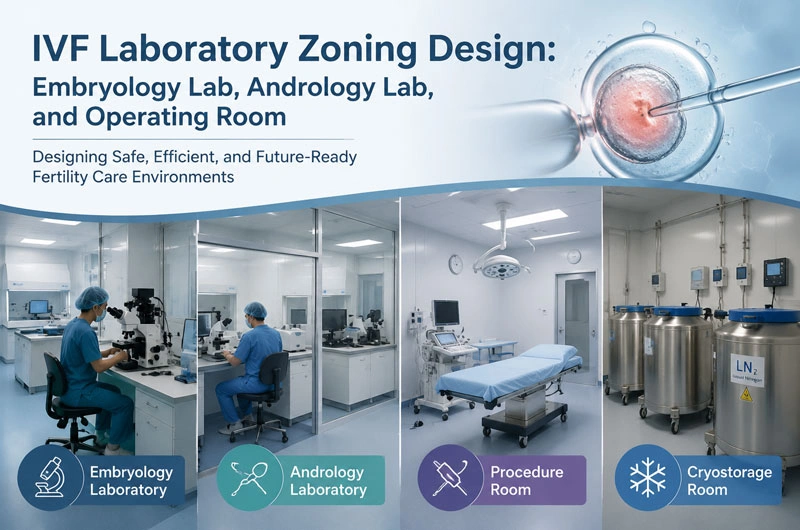
In vitro fertilization (IVF) laboratories are among the most sensitive medical environments in modern healthcare. Unlike conventional medical spaces, an IVF facility is not only designed for human operation but also for protecting microscopic biological materials—oocytes, sperm, embryos, and reproductive cells—that are extremely vulnerable to environmental fluctuations.
A successful IVF laboratory design is not simply about dividing rooms according to functions. The real challenge is creating a controlled biological workflow where every movement, air exchange, pressure relationship, temperature variation, and human interaction is carefully managed.
A well-designed IVF laboratory should answer three critical questions:
- How can biological samples move safely through different stages?
- How can contamination risks be minimized without affecting workflow efficiency?
- How can laboratory spaces support future expansion and increasing treatment volumes?
This is why professional IVF laboratory zoning usually includes four core functional areas:
- Embryology Laboratory
- Andrology Laboratory
- Procedure Room
- Cryostorage Room
Each zone has a different purpose, environmental requirement, and relationship with other spaces.
1. Embryology Laboratory
The embryology laboratory is the most critical area within an IVF facility. It is where eggs and embryos are handled, fertilized, cultured, and evaluated.
Unlike ordinary cleanrooms, an embryology lab requires not only cleanliness but also biological stability.
A single environmental disturbance—such as VOC emissions, temperature fluctuation, or poor airflow design—may affect embryo development.
Key Functions of Embryology Laboratory
The embryology room typically accommodates:
- Oocyte identification and preparation
- Intracytoplasmic sperm injection (ICSI)
- Fertilization procedures
- Embryo culture
- Embryo grading and evaluation
- Embryo transfer preparation
The space usually includes:
- IVF workstations
- Microscopes
- ICSI equipment
- CO₂ incubators
- Laminar airflow workstations
- Embryo storage preparation areas
Design Principle
A common misconception is that IVF laboratories should follow the same design logic as operating rooms.
However, IVF laboratories have a different priority:
- Operating rooms mainly protect patients from infection.
- IVF laboratories mainly protect embryos from environmental stress.
Therefore, IVF zoning focuses heavily on:
- Low VOC materials
- Stable temperature control
- HEPA-filtered air
- Minimal chemical exposure
- Controlled personnel movement
For example, standard construction materials such as adhesives, paints, sealants, and flooring may release volatile organic compounds (VOCs). These substances can potentially affect embryo development.
Therefore, IVF laboratories often require:
- Low-emission wall panels
- Medical-grade flooring
- Formaldehyde-controlled materials
- Easy-to-clean surfaces
2. Andrology Laboratory
The andrology laboratory handles male reproductive samples, including semen analysis and sperm preparation.
Although it may appear less critical than the embryology laboratory, the andrology room plays an essential role because sperm quality directly affects fertilization outcomes.
Main Functions
The andrology room usually includes:
- Semen collection room
- Sample receiving area
- Semen analysis workstation
- Sperm washing area
- Sperm preparation equipment
Common procedures include:
- Semen evaluation
- Sperm concentration testing
- Motility analysis
- Morphology assessment
- Sperm preparation for IVF/ICSI
Zoning Consideration
One of the most important IVF laboratory design concepts is preventing cross-contamination between incoming samples and processed biological materials.
A poorly planned layout may create unnecessary movement:
Sample collection → public corridor → laboratory → processing area
This increases risks related to:
- Temperature changes
- Sample identification errors
- Human traffic
- Contamination
A better workflow is:
Patient Collection Area → Sample Transfer Window → Andrology Laboratory → Embryology Laboratory
This creates a controlled one-way movement.
Independent Andrology Room or Integrated Laboratory?
Different IVF centers may choose different approaches.
Option 1: Independent Andrology Laboratory
Advantages:
- Better privacy
- Reduced cross-traffic
- Easier workflow control
Suitable for:
- Large fertility centers
- High patient volume clinics
Option 2: Integrated IVF Laboratory
Advantages:
- Reduced construction cost
- Shorter sample transfer distance
- Suitable for small clinics
The choice depends on:
- Daily IVF cycle volume
- Available building space
- Expansion plans
3. Procedure Room
The procedure room is the bridge between the IVF laboratory and patient care.
Typical procedures include:
- Egg retrieval (OPU)
- Embryo transfer (ET)
Unlike conventional operating rooms, IVF procedure rooms have unique requirements.
Location Strategy
One of the most important IVF zoning principles is:
The shorter the distance between procedure room and embryology laboratory, the lower the biological risk.
For example:
During oocyte retrieval:
Patient → Procedure Room → Collected oocytes → Embryology Laboratory
The oocytes must be transported quickly under controlled conditions.
A well-designed IVF facility often places:
- Procedure room
- Embryology laboratory
- Transfer preparation area
within the same controlled zone.
Key Design Features
A professional IVF procedure room should consider:
Positive Pressure Environment
Positive pressure prevents contaminated air from entering when doors open.
HEPA Filtration
High-efficiency filtration helps maintain stable air quality.
Ergonomic Workflow
Equipment positioning should reduce unnecessary movement between:
- Patient bed
- Ultrasound system
- Medical gases
- Laboratory pass-through system
4. Cryostorage Room
Cryostorage is often underestimated during IVF planning.
However, frozen embryos and reproductive cells may need to be preserved for many years.
The cryostorage room protects:
- Embryos
- Oocytes
- Sperm samples
through ultra-low temperature storage.
Key Requirements of Cryostorage Design
Unlike other IVF rooms, cryostorage focuses on:
- Safety
- Monitoring
- Backup systems
Essential systems include:
Liquid Nitrogen Storage Management
Cryogenic tanks require:
- Stable placement areas
- Ventilation systems
- Oxygen monitoring
Because liquid nitrogen can displace oxygen in enclosed spaces, oxygen deficiency monitoring is critical.
Backup and Emergency Planning
A professional cryostorage design should consider:
- Backup nitrogen supply
- Alarm systems
- Temperature monitoring
- Emergency response procedures
A failure in cryostorage is not simply an equipment problem—it can represent years of patient reproductive investment.
5. Recommended IVF Laboratory Zoning Relationship
A scientifically planned IVF laboratory usually follows this workflow:
Patient Area

      ↓

Consultation / Preparation

      ↓

Procedure Room

      ↓

Embryology Laboratory

      ↓

Cryostorage Room


Male Sample Collection

      ↓

Andrology Laboratory

      ↓

Embryology Laboratory
The ideal design principle is:
Reduce unnecessary movement, separate different workflows, and maintain controlled environmental conditions.
6. Designing for Future IVF Growth
Many IVF facilities focus only on current requirements but overlook future expansion.
A forward-looking IVF laboratory should reserve space for:
- Additional incubators
- More procedure rooms
- Extra cryostorage capacity
- Increased laboratory staff
- Advanced technologies such as AI embryo assessment
For example, a clinic performing 300 IVF cycles annually may eventually grow into a center handling thousands of cycles.
Our flexible modular IVF laboratory design allows:
- Faster expansion
- Lower renovation costs
- Minimal disruption to ongoing treatment