
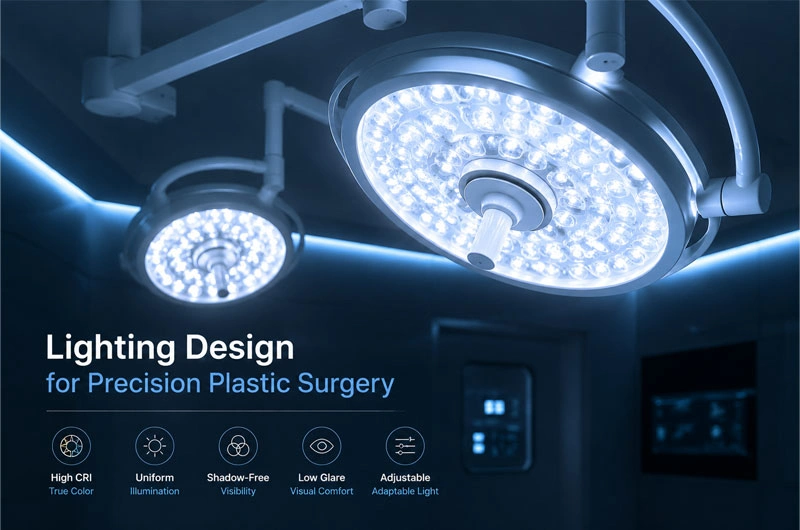
Plastic surgery is one of the few medical specialties where millimeters determine both functional and aesthetic outcomes. Whether performing rhinoplasty, facelift surgery, blepharoplasty, breast reconstruction, or microsurgical flap procedures, surgeons rely heavily on subtle visual cues—skin texture, tissue color, vascular perfusion, and facial symmetry.
While hospitals often invest heavily in advanced surgical instruments, imaging systems, and laminar airflow ceilings, lighting design is frequently underestimated. In reality, poorly designed lighting can increase surgeon fatigue, distort tissue color, create shadows, and ultimately affect surgical precision.
This article explores how modern lighting design should be planned specifically for plastic surgery operating rooms, offering practical insights beyond standard operating theatre guidelines.
Why Plastic Surgery Requires Different Lighting Than General Surgery
Unlike orthopedic or abdominal surgery, plastic surgery involves:
- Fine soft tissue manipulation
- Color-sensitive procedures
- Microsuturing
- Long operating times
- High cosmetic expectations
For example:
| Surgical Specialty | Primary Visual Requirement |
|---|---|
| Orthopedics | Deep cavity illumination |
| Cardiac Surgery | High penetration into narrow spaces |
| Neurosurgery | Microscope-assisted visualization |
| Plastic Surgery | Color accuracy and shadow-free surface lighting |
Plastic surgeons continuously evaluate:
- Skin tone
- Blood perfusion
- Tissue thickness
- Scar edges
- Facial symmetry
- Tiny blood vessels
Lighting must therefore optimize surface visualization, not merely provide high brightness.
The Five Core Principles of Plastic Surgery Lighting Design
1. High Color Rendering Index (CRI)
One of the biggest mistakes is selecting lights based solely on illuminance (Lux).
Equally important is Color Rendering Index (CRI).
Recommended:
| Parameter | Recommended Value |
|---|---|
| CRI | ≥95 |
| R9 (Red Rendering) | >90 |
High CRI lighting allows surgeons to distinguish:
- Healthy tissue
- Bruised tissue
- Ischemic tissue
- Fat layers
- Skin pigmentation
- Small capillaries
Poor CRI lighting can make all tissues appear similar, increasing decision difficulty.
2. Adjustable Color Temperature
Plastic surgery includes multiple procedural stages.
Different color temperatures enhance different tasks.
| Stage | Recommended Color Temperature |
|---|---|
| Incision | 4300–4500K |
| Tissue Dissection | 4500–5000K |
| Microsuturing | 5000–5500K |
| Skin Closure | 4000–4500K |
Rather than using fixed lighting, many premium operating rooms now use variable white LED systems.
This allows surgeons to optimize visibility throughout the procedure.
3. Shadow Elimination
Plastic surgery often requires surgeons to work extremely close to the operative field.
Multiple hands, microscopes, suction devices, cameras, and assistants frequently block light.
An effective lighting system should provide:
- Multi-reflector optical design
- Multiple overlapping light beams
- Automatic shadow compensation
- Dynamic beam adjustment
Instead of one powerful light source, several coordinated light sources provide more uniform illumination.
Lighting Uniformity Matters More Than Peak Brightness
Many hospitals specify:
160,000 Lux
While impressive on paper, peak brightness alone is not enough.
Consider two operating rooms.
Operating Room A
- 160,000 Lux center
- Significant brightness drop near edges
- Sharp shadows
Operating Room B
- 120,000 Lux
- Excellent uniformity
- Minimal glare
- Even edge illumination
Most plastic surgeons would prefer Operating Room B.
Uniform illumination reduces:
- Eye adaptation
- Constant pupil adjustment
- Visual fatigue
- Surgical interruptions
Glare Reduction Improves Surgeon Endurance
Plastic surgery procedures often last:
- 4 hours
- 6 hours
- 8 hours
- 10+ hours
Excessive glare causes:
- Eye strain
- Dry eyes
- Reduced concentration
- Neck fatigue from adjusting viewing angles
Modern surgical lighting minimizes glare through:
- Anti-reflective optical lenses
- Diffused LED arrays
- Deep reflector geometry
- Intelligent beam shaping
The goal is comfortable visibility, not simply maximum intensity.
True Color Is Critical During Reconstruction
In reconstructive surgery, tissue viability is evaluated largely by appearance.
Surgeons observe:
- Pinkness
- Capillary refill
- Venous congestion
- Arterial perfusion
- Skin blanching
If lighting shifts tissue color toward blue or yellow, surgeons may misjudge tissue health.
This is especially important during:
- Free flap reconstruction
- Skin grafting
- Burn surgery
- Facial reconstruction
Lighting should preserve natural tissue appearance as closely as possible.
Ceiling Lighting Should Complement Surgical Lights
Many operating rooms focus only on surgical lamps.
However, ambient ceiling lighting also plays an important role.
Good ambient lighting should:
- Eliminate excessive room contrast
- Reduce adaptation when surgeons look away
- Improve circulation staff visibility
- Enhance equipment handling
- Support photography documentation
Recommended ambient illumination:
- 300–500 Lux (general room)
- Dimmable control
- Flicker-free LEDs
Lighting Integration with Modern Plastic Surgery Technology
Modern plastic surgery operating rooms increasingly incorporate:
- Surgical microscopes
- 3D visualization systems
- HD recording
- Robotic assistance
- AI-assisted imaging
- Navigation systems
Lighting must avoid interference with:
- Camera white balance
- Video recording
- Image sensors
- Optical navigation markers
Integrated digital control enables synchronized adjustment of lighting intensity, beam size, and camera settings, ensuring consistent visualization throughout the procedure.
Sterility and Maintenance Considerations
Lighting fixtures are part of the cleanroom environment.
They should support infection control by featuring:
- Smooth sealed surfaces
- Dust-resistant construction
- Easy disinfection
- Low heat generation
- Minimal airflow disturbance
LED surgical lights offer additional benefits:
| Feature | Clinical Benefit |
|---|---|
| Low infrared emission | Reduced tissue drying |
| Minimal ultraviolet output | Less heat stress |
| Long service life | Lower maintenance costs |
| Instant start-up | No warm-up delay |
| Low power consumption | Improved energy efficiency |
These characteristics align well with the requirements of modern modular operating theatres.
Lighting Design Should Match Surgical Workflow
A common design mistake is treating lighting as an isolated system. In reality, it should be coordinated with the entire operating room layout.
For plastic surgery suites, lighting should be planned alongside:
- Laminar airflow ceiling placement
- Surgical table positioning
- Ceiling-mounted booms
- Medical gas outlets
- HD camera systems
- Microscope mounting
- Ceiling service panels
Early coordination prevents issues such as blocked light paths, equipment collisions, and compromised sterile airflow.
Emerging Trends in Plastic Surgery Lighting
Future operating rooms are moving beyond manual adjustments toward intelligent, adaptive systems. Key developments include:
| Trend | Clinical Value |
|---|---|
| AI-assisted light positioning | Automatically follows the surgical field |
| Gesture or voice control | Hands-free adjustment within the sterile field |
| Adaptive beam shaping | Optimizes illumination for changing incision sizes |
| Integrated imaging synchronization | Aligns lighting with cameras and surgical displays |
| Human-centric lighting | Reduces eye fatigue during lengthy procedures |
As surgical technologies evolve, lighting is becoming an active contributor to precision rather than a passive source of illumination.