
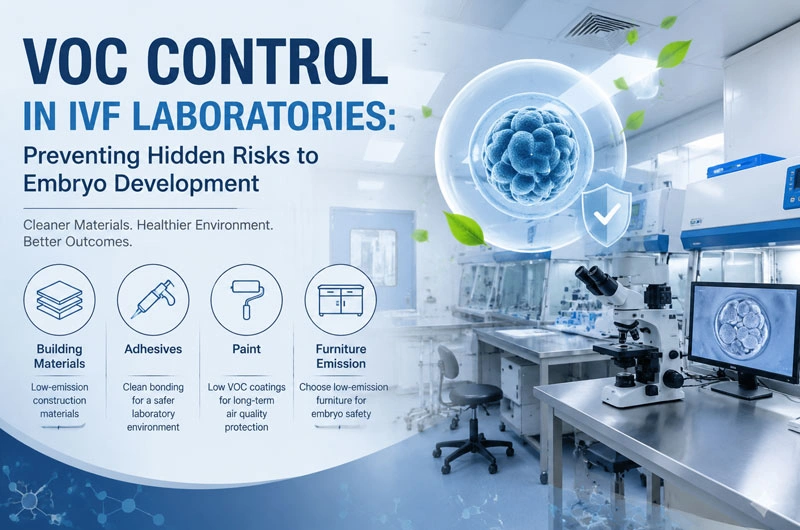
In vitro fertilization (IVF) laboratories are among the most sensitive environments within modern healthcare facilities. Unlike conventional clinical spaces, where environmental quality mainly affects human comfort and infection control, IVF laboratories directly influence the earliest stages of human life.
During embryo culture, fertilization, and incubation, embryos are exposed to their surrounding environment through culture media and controlled incubation systems. Even extremely low concentrations of airborne contaminants may interfere with embryo metabolism, cellular division, implantation potential, and overall developmental competence.
While IVF laboratories typically focus on temperature, humidity, HEPA filtration, and particle control, one hidden risk is often underestimated: volatile organic compounds (VOCs).
VOCs are chemical compounds released from common construction and interior materials. They may remain in the laboratory environment for months or even years after installation. Unlike visible dust or microbial contamination, VOC contamination is invisible, odorless at low concentrations, and difficult to detect without professional monitoring.
For IVF laboratory designers and hospitals, VOC control should not be considered only a cleanroom requirement—it should be viewed as a critical factor in protecting embryo viability.
1. Why VOC Control Matters in IVF Laboratories
Early embryos do not have mature detoxification mechanisms. Their development depends on precisely balanced biochemical processes, including:
- DNA replication
- Cell division
- Mitochondrial activity
- Gene expression
- Energy metabolism
Certain VOCs may interfere with these processes by:
- Creating oxidative stress
- Affecting cellular signaling pathways
- Altering pH stability in culture environments
- Increasing the risk of developmental abnormalities
Common VOC sources include:
- Formaldehyde
- Benzene
- Toluene
- Xylene
- Ethylbenzene
- Styrene
- Aldehydes from synthetic materials
Even when concentrations meet general indoor air standards, IVF laboratories may require much stricter control because embryos represent a highly vulnerable biological system.
2. Building Materials: The Foundation of a Low-VOC IVF Environment
Many IVF laboratory projects focus heavily on cleanroom classification and airflow design but overlook the impact of construction materials.
The walls, ceilings, flooring, and insulation materials form the largest surface area inside the laboratory. If these materials continuously release VOCs, the contamination source exists throughout the entire facility.
Risks from Conventional Building Materials
Common construction materials may contain:
- Formaldehyde-based resins
- Plasticizers
- Solvent residues
- Chemical additives
For example:
Composite Wood Products
Traditional MDF, plywood, and particle boards often use urea-formaldehyde adhesives. Over time, they can release formaldehyde into indoor air.
In an IVF environment, this creates a long-term contamination source that cannot be eliminated simply through ventilation.
Flooring Materials
Some PVC flooring systems may emit:
- Phthalates
- Residual solvents
- Plasticizer compounds
Although emission levels may appear acceptable in ordinary buildings, IVF laboratories require a higher standard due to embryo sensitivity.
Recommended Approach: Select Materials Designed for Controlled Environments
A suitable IVF laboratory should prioritize:
Low-emission sandwich panels
High-quality modular laboratory systems commonly use:
- Powder-coated steel panels
- Antibacterial coated surfaces
- Aluminum composite panels
- Cleanroom-grade materials
These materials provide:
- Low VOC emission
- Smooth surfaces
- Easy cleaning
- Chemical resistance
- Long-term stability
Modular construction advantage
Compared with traditional construction, modular IVF laboratories allow manufacturers to control:
- Panel materials
- Surface coatings
- Sealants
- Installation methods
This reduces uncertainty regarding hidden chemical emissions.
3. Adhesives: A Small Component With a Big Impact
Adhesives are often overlooked because they represent only a small percentage of the laboratory structure.
However, adhesives can become significant VOC sources because they contain chemical components designed for bonding performance.
Common VOC Sources From Adhesives
Examples include:
- Solvent-based adhesives
- Construction sealants
- Flooring adhesives
- Panel bonding materials
These may release:
- Ketones
- Aromatic hydrocarbons
- Aldehydes
The problem is not only initial emissions after installation.
Some adhesives continue releasing low levels of VOCs for extended periods, especially under:
- Higher temperatures
- Poor ventilation
- Humid conditions
Better Solution: Use Cleanroom-Compatible Adhesive Systems
For IVF laboratories, preferred adhesive technologies include:
Water-based adhesives
Advantages:
- Lower VOC emissions
- Reduced odor
- Better environmental compatibility
High-solid or solvent-free adhesives
Advantages:
- Less chemical evaporation
- Better long-term stability
Factory-controlled bonding processes
In modular IVF laboratory manufacturing, many bonding processes can be completed in controlled factory environments rather than on-site.
This provides:
- More consistent quality
- Reduced installation contamination
- Better curing conditions
4. Paint and Surface Coatings: The Hidden Chemical Layer
Paint is another underestimated VOC source.
A newly painted laboratory may appear clean and modern, but coating materials can release VOCs during curing.
VOC Risks From Paint
Traditional paints may contain:
- Solvent carriers
- Formaldehyde-releasing additives
- Anti-microbial chemicals
- Plasticizers
The highest emission period usually occurs shortly after application, but some compounds may continue releasing for months.
IVF Laboratory Paint Requirements
Ideal coatings should have:
Low VOC certification
Materials should comply with international standards such as:
- ISO cleanroom requirements
- Indoor air quality standards
- Healthcare environmental requirements
Chemical resistance
The surface should withstand:
- Disinfectants
- Hydrogen peroxide cleaning
- Alcohol-based cleaners
Smooth, non-porous surfaces
A good IVF laboratory coating should:
- Prevent particle accumulation
- Avoid microbial growth
- Support effective cleaning
5. Furniture and Equipment Emissions: The Overlooked Source
Laboratory furniture is often introduced after construction, but it can become one of the longest-lasting VOC sources.
Common examples include:
- Storage cabinets
- Laboratory desks
- Workstations
- Chairs
- Wooden furniture
Why Furniture Matters
Furniture often contains:
- Engineered wood
- Adhesive layers
- Laminates
- Plastic components
- Foam materials
These materials may continuously emit VOCs into the laboratory environment.
Because furniture is located close to working areas, local VOC concentration can be higher than average room measurements.
Recommended IVF Laboratory Furniture Design
Professional IVF laboratories should consider:
Stainless steel furniture
Benefits:
- Zero formaldehyde emission
- Easy sterilization
- High chemical resistance
Cleanroom-grade cabinets
Features:
- Sealed edges
- Low-emission materials
- Smooth surfaces
Integrated modular design
Instead of adding furniture after construction, modular IVF solutions integrate:
- Storage cabinets
- Laboratory benches
- Equipment spaces
during the design stage.
This minimizes material uncertainty and improves environmental control.
6. VOC Control Requires a Whole-System Strategy
A common misconception is that VOC problems can be solved through stronger ventilation.
However, ventilation only reduces concentration. It does not eliminate the emission source.
A successful IVF laboratory VOC strategy requires:
1. Source Control
Select:
- Low-VOC materials
- Certified coatings
- Cleanroom-grade components
2. Controlled Installation
Prevent contamination during:
- Construction
- Transportation
- Assembly
3. Pre-Operation Purging
Before IVF operation:
- Flush the environment
- Monitor VOC levels
- Validate air quality
4. Continuous Monitoring
Advanced IVF laboratories may integrate:
- VOC sensors
- Environmental monitoring systems
- Alarm functions
to identify abnormal changes.