
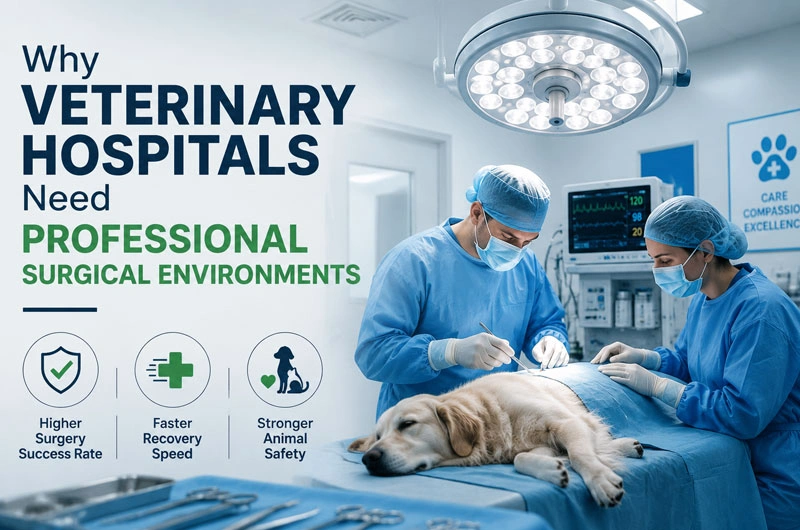
In veterinary medicine, surgical outcomes are often associated with the surgeon’s skills, anesthesia protocols, and advanced medical equipment. However, one critical factor is frequently underestimated: the surgical environment itself.
A professional veterinary surgical environment is not simply a clean room with operating lights and surgical tables. It is a carefully engineered ecosystem designed to control invisible risks — airborne contamination, temperature fluctuations, unnecessary movement, equipment interference, and workflow inefficiencies.
For veterinary hospitals, investing in a professional surgical environment is not only about improving hygiene standards. It directly influences:
- Surgery success rate
- Recovery speed
- Animal safety
- Hospital reputation and operational efficiency
A well-designed surgical space gives veterinarians better control over every factor that affects patient outcomes.
1. Surgical Environment Directly Influences Surgery Success Rate
1.1 Infection Control Begins With Air Quality
During surgery, an animal’s tissues and immune defenses are temporarily vulnerable. Even a small number of airborne microorganisms entering the surgical site can increase the risk of postoperative infections.
Unlike humans, many veterinary patients cannot understand or follow postoperative instructions. Dogs may lick wounds, cats may hide signs of discomfort, and exotic animals may deteriorate quickly after complications occur.
Therefore, preventing contamination during surgery becomes even more important.
A professional veterinary operating environment uses:
- HEPA-filtered air systems
- Controlled airflow patterns
- Positive pressure ventilation
- Proper air exchange rates
- Smooth, antibacterial interior surfaces
These systems help create a cleaner surgical zone by reducing airborne particles and preventing contaminated air from entering the operating area.
The goal is not simply to make the room “clean.” The goal is to maintain predictable environmental conditions throughout the entire procedure.
1.2 Stable Environmental Conditions Improve Surgical Precision
Many veterinary procedures require extreme precision, including:
- Orthopedic surgery
- Neurosurgery
- Soft tissue reconstruction
- Ophthalmic surgery
- Minimally invasive procedures
Environmental instability can indirectly affect surgical performance.
For example:
- Excessive temperature changes may influence anesthesia stability.
- Poor lighting design may reduce surgical visibility.
- Improper room layout may force unnecessary movement around the patient.
- Equipment congestion may increase procedural interruptions.
A professionally designed veterinary surgical theatre considers every movement:
Where should the surgeon stand?
Where should instruments be placed?
How should assistants move?
Where should anesthesia equipment be positioned?
A well-planned workflow reduces distractions and allows the surgical team to focus entirely on the patient.
2. A Professional Environment Helps Animals Recover Faster
2.1 Lower Infection Risk Means Shorter Recovery Time
Postoperative infection is one of the major causes of delayed recovery.
When surgical wounds become infected, animals may experience:
- Longer healing periods
- Additional medication requirements
- Increased pain
- Extended hospitalization
- Higher treatment costs
A controlled surgical environment reduces contamination risks before they become clinical problems.
For veterinary hospitals, this means:
Better environmental control → fewer complications → faster recovery → improved patient outcomes
2.2 Temperature and Humidity Control Are Especially Important for Animals
Animals respond differently to environmental conditions compared with humans.
Small animals, elderly pets, and exotic species are particularly sensitive to temperature changes during surgery.
During anesthesia:
- Body temperature regulation decreases
- Heat loss increases
- Recovery may become slower
A professional surgical environment maintains appropriate:
- Temperature stability
- Humidity levels
- Air movement
This supports anesthesia management and helps animals return to normal physiological conditions more efficiently after surgery.
3. Professional Surgical Environments Improve Animal Safety
3.1 Reducing Invisible Risks Beyond Infection
Animal safety involves more than preventing bacteria.
A modern veterinary surgical environment also addresses:
Airborne particles
Dust and microorganisms can compromise sterile procedures.
Noise and stress factors
Excessive noise and chaotic movement can increase animal stress before and after procedures.
Workflow errors
Poor layouts can increase the chance of mistakes during complex operations.
Equipment accessibility
Emergency equipment must always be quickly reachable.
A professional veterinary operating room is designed around risk reduction.
Every wall panel, air grille, door position, and equipment location has a purpose.
3.2 Veterinary Patients Require Higher Environmental Control
Human patients can communicate symptoms, discomfort, or unusual sensations.
Animals cannot.
A dog cannot tell the surgical team:
“I feel colder than normal.”
A cat cannot report:
“My wound feels painful.”
Veterinarians must rely on clinical observation and environmental management.
This makes the surgical environment even more important.
The room itself becomes part of the treatment system.
4. Professional Surgical Design Improves Veterinary Hospital Efficiency
Many veterinary hospitals focus only on purchasing advanced equipment. However, inefficient environments can limit the value of those investments.
A professionally designed surgical facility improves:
Staff efficiency
Optimized layouts reduce unnecessary walking and preparation time.
Cleaning efficiency
Seamless surfaces and specialized materials simplify sterilization.
Equipment management
Dedicated zones prevent overcrowding and improve organization.
Future expansion
Modular pet surgery operating room allows hospitals to upgrade or expand without major disruption.
This is especially valuable as veterinary hospitals increasingly provide advanced procedures similar to human healthcare facilities.
Conclusion
For modern veterinary hospitals, investing in a professionally designed operating environment means investing in:
- Safer procedures
- Faster recovery
- Higher-quality veterinary care
- Greater trust from pet owners
The future of veterinary surgery begins not only with better technology, but with better environments.